
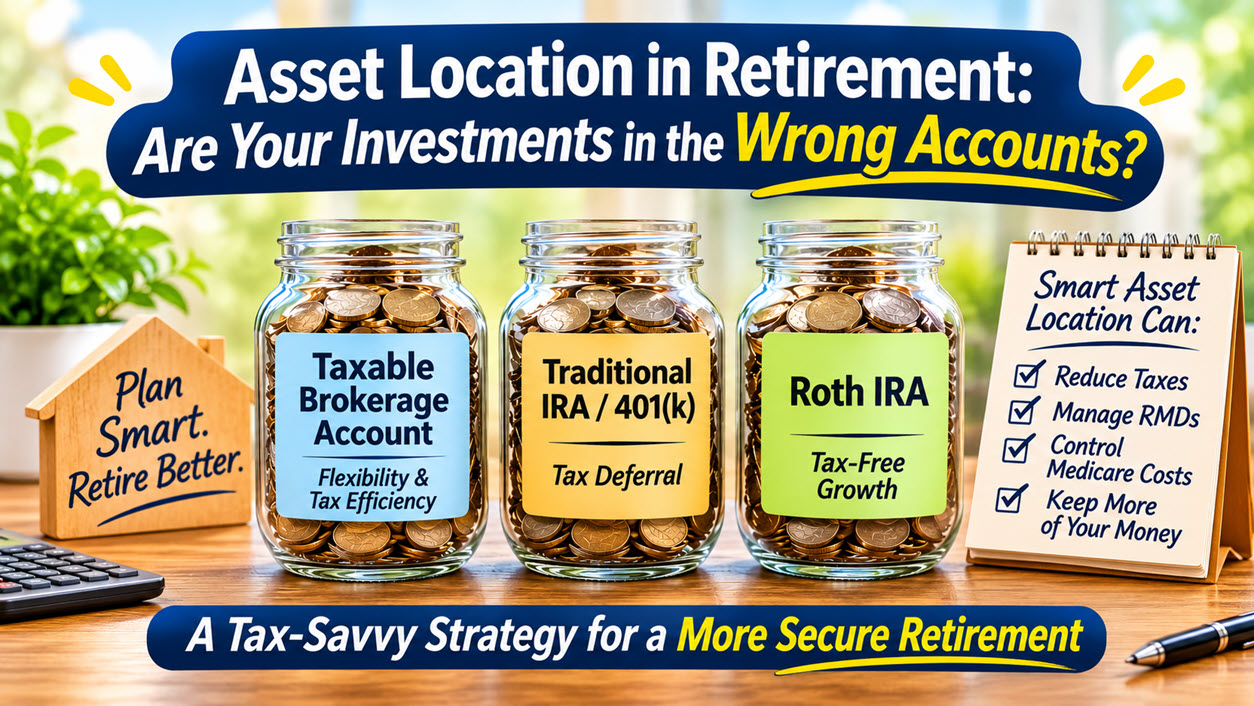
Why Where You Invest May Matter Just as Much as What You Invest
When people think about preparing for retirement, they typically focus on three questions:
- How much money do I need to retire comfortably?
- How should I divide my investments between stocks, bonds, and cash?
- How much investment risk should I take as I approach retirement?
These are important questions, but there is another question that deserves just as much attention:
Are you holding the right investments in the right accounts?
This is an often-overlooked part of retirement planning that can have a meaningful impact on how much money you ultimately keep.
Consider two households approaching retirement. Both have $2 million invested, maintain the same overall investment allocation, earn identical investment returns, and withdraw the same amount of money each year.
Yet, over time, one household could pay substantially more in taxes than the other.
Why?
Because the investments are held in different types of accounts.
This concept is known as asset location, and when coordinated with your investment allocation, withdrawal strategy, and tax planning, it can help improve the after-tax value of your retirement portfolio.
The objective isn’t simply to accumulate more money. It is to retain more of the money you have worked so hard to accumulate.
Let’s examine how this works.
1. Asset Allocation vs. Asset Location: Understanding the Difference
These two terms sound similar, but they address two different investment decisions.
Asset Allocation: What Do You Own?
Asset allocation determines how your investments are divided among different asset classes.
For example, someone with a $1 million retirement portfolio might choose:
| Investment | Allocation | Dollar Amount |
|---|---|---|
| Stocks | 60% | $600,000 |
| Bonds | 30% | $300,000 |
| Cash | 10% | $100,000 |
| Total | 100% | $1,000,000 |
This allocation determines the portfolio’s overall investment risk, growth potential, and exposure to market fluctuations.
Asset Location: Where Do You Hold It?
Asset location determines which investment accounts hold those investments.
Most retirees have some combination of:
- Taxable brokerage accounts: Investment accounts where dividends, interest, and realized capital gains may create taxable income.
- Traditional IRAs and 401(k)s: Tax-deferred accounts where contributions may have received an upfront tax deduction, and withdrawals are generally taxed as ordinary income.
- Roth IRAs and Roth 401(k)s: Accounts that can provide tax-free qualified withdrawals when applicable requirements are satisfied.
You could have exactly the same 60% stock and 40% bond allocation across your entire retirement portfolio but organize those investments differently among your accounts.
That distinction can affect your lifetime tax liability.
The important principle is that asset allocation and asset location should be evaluated together rather than treated as separate investment decisions.
2. Why Your Account Selection Can Change Your Retirement Tax Bill
Let’s consider a hypothetical couple with $1 million invested:
- Traditional IRA: $500,000
- Roth IRA: $500,000
Their investment objective is to maintain a 60% stock and 40% bond allocation.
They have two possible approaches.
Strategy A: Divide Investments Equally Between Accounts
They could place a combination of stocks and bonds in both accounts.
| Account | Stocks | Bonds | Total |
|---|---|---|---|
| Traditional IRA | $300,000 | $200,000 | $500,000 |
| Roth IRA | $300,000 | $200,000 | $500,000 |
| Total | $600,000 | $400,000 | $1,000,000 |
This is straightforward and maintains the desired portfolio allocation.
However, it doesn’t necessarily maximize the potential tax advantages of their different account types.
Strategy B: Place Investments More Strategically
Instead, they could consider holding more of their bonds in the Traditional IRA and more of their long-term growth investments in the Roth IRA.
For illustration:
| Account | Stocks | Bonds | Total |
|---|---|---|---|
| Traditional IRA | $100,000 | $400,000 | $500,000 |
| Roth IRA | $500,000 | $0 | $500,000 |
| Total | $600,000 | $400,000 | $1,000,000 |
Notice something important.
The overall portfolio still contains exactly 60% stocks and 40% bonds.
The household has not increased its overall stock exposure or changed its investment allocation. It has simply changed where those investments are held.
If the stocks outperform bonds over the long term, a greater portion of that growth could accumulate inside the Roth IRA, where qualified withdrawals can be tax-free.
Meanwhile, the Traditional IRA holds more of the slower-growing investments, potentially limiting the future growth of an account whose distributions are generally subject to ordinary income tax.
This is the basic premise of strategic asset location.
It is important to recognize that this is an illustrative strategy, not a universal prescription. Actual account balances, investment risk, liquidity needs, and future tax circumstances determine whether this arrangement makes sense.
3. How Different Investments Are Taxed
Before deciding which investments belong in which accounts, you need to understand how different investments are taxed.
Not all investment returns receive the same tax treatment.
A. Bonds and Fixed-Income Investments
Traditional bonds, Treasury securities, and many fixed-income investments generate interest income.
When held in a taxable brokerage account, that interest is generally taxable in the year it is received, even if you reinvest the interest rather than spend it.
For example:
Suppose you have $200,000 invested in bonds earning 4% annually.
Your annual interest income would be:
$200,000 × 4% = $8,000
If that interest is subject to a combined marginal federal and state tax rate of 30%, approximately $2,400 could go toward taxes.
That leaves $5,600 to reinvest.
Over many years, this annual tax expense can reduce the amount available for compounding.
This is commonly referred to as tax drag.
Potential strategy: Consider holding ordinary-income-producing bonds and fixed-income investments in Traditional IRAs or 401(k)s, where the interest can compound without creating an annual taxable distribution to you.
Taxes generally become due when money is withdrawn from the tax-deferred account.
There are exceptions worth considering. For example, Treasury interest is generally exempt from state and local income taxes, and municipal bond interest may receive favorable federal and potentially state tax treatment depending on the bond.
The after-tax yield should always be compared before deciding where to hold these investments.
B. Stocks and Equity Investments
Stocks can produce returns through price appreciation and dividends.
These returns can receive different tax treatment depending on the account and investment.
In a taxable brokerage account:
- Qualified dividends generally receive preferential federal tax rates.
- Long-term capital gains generally receive preferential federal tax rates.
- Unrealized capital gains generally aren’t taxed until the investment is sold.
- Tax-loss harvesting may help offset capital gains and, subject to applicable limitations, certain ordinary income.
- Appreciated investments may offer estate-planning advantages when transferred to heirs.
This flexibility makes taxable brokerage accounts potentially very tax-efficient for long-term stock investments.
There is another important consideration.
If you have appreciated investments that you don’t need to sell, you may be able to hold them for many years without triggering capital gains taxes.
Under current federal law, qualifying inherited investments generally receive a basis adjustment to fair market value at the owner’s death, subject to applicable rules and exceptions.
This can create an additional estate-planning benefit.
C. Real Estate Investment Trusts (REITs)
REITs deserve special attention.
Although REITs trade similarly to stocks, their distributions frequently receive different tax treatment from qualified stock dividends.
Much of a REIT’s ordinary distribution may be taxed as ordinary income in a taxable brokerage account.
Certain REIT distributions may qualify for the Section 199A deduction, subject to current law and individual eligibility.
Because of this tax treatment, REITs may be better candidates for tax-deferred accounts than taxable brokerage accounts.
However, the decision should consider the investment’s total return, distribution characteristics, and the tax treatment of eventual withdrawals.
D. Mutual Funds and Exchange-Traded Funds
Not all funds are equally tax-efficient.
Some actively managed mutual funds distribute capital gains to shareholders, potentially creating taxable income even when the investor hasn’t sold any shares.
Many index ETFs are structured to be more tax-efficient, although their tax treatment still depends on their holdings and distributions.
When investing in taxable accounts, consider:
- Portfolio turnover.
- Dividend distributions.
- Capital gain distributions.
- Expense ratios.
- Tax-loss harvesting opportunities.
A fund’s investment return is only part of the equation. Its tax efficiency also matters.
4. The Three Retirement Accounts Should Serve Different Purposes
Think of your retirement savings as three different tax environments.
Each account offers different advantages and limitations.
Taxable Brokerage Account: Flexibility and Control
A taxable brokerage account can be an important source of retirement income.
Advantages include:
- No required minimum distributions.
- Access to money at any age without retirement-account early withdrawal penalties.
- Control over when many capital gains are realized.
- Opportunities for tax-loss harvesting.
- Potential estate-planning advantages.
This account can be especially useful for maintaining liquidity during the early years of retirement.
However, interest, dividends, and realized capital gains can increase your taxable income.
Traditional IRA or 401(k): Tax Deferral
Traditional retirement accounts offer the opportunity to defer taxes while investments grow.
However, the tax bill eventually arrives when distributions are taken.
Withdrawals are generally taxed as ordinary income, with certain exceptions for after-tax contributions and other special circumstances.
One important retirement consideration is required minimum distributions (RMDs).
Under current law, many traditional retirement account owners must begin taking RMDs at age 73 or 75, depending on their birth year and applicable rules.
These distributions can increase taxable income whether or not you actually need the money.
That additional income may also affect other retirement-related tax calculations.
Roth IRA: Potentially Tax-Free Retirement Income
Roth accounts can be particularly valuable because qualified withdrawals are tax-free.
Unlike Traditional IRAs, original Roth IRA owners aren’t subject to lifetime RMDs.
This creates an opportunity to allow investments to compound for many years without being forced to withdraw money.
Roth accounts can also provide valuable flexibility when managing taxable retirement income.
For example, if you need additional money in a particular year, a qualified Roth withdrawal generally won’t increase your federal adjusted gross income.
This can be particularly useful when managing Medicare premium thresholds and the taxation of Social Security benefits.
However, Roth contribution and conversion rules, holding periods, and qualified distribution requirements must be considered.
5. Why Asset Location Can Affect RMDs, Social Security, and Medicare Premiums
This is where asset location becomes especially important.
The tax consequences of your investment decisions don’t necessarily end with the taxes paid on investment income.
They can also influence other parts of your retirement finances.
Required Minimum Distributions
Traditional retirement accounts generally require distributions beginning at the applicable RMD age.
The calculation is generally based on the prior December 31 account balance divided by an IRS life-expectancy factor.
The larger the traditional retirement account becomes, the larger the required distribution may be.
By strategically locating investments, you may be able to influence the future balance of your tax-deferred accounts.
For example, placing some slower-growing investments in a Traditional IRA while holding suitable long-term growth investments in a Roth IRA may reduce the future size of the Traditional IRA relative to an alternative arrangement.
This does not eliminate RMDs, but it may help manage future taxable distributions.
Social Security Taxation
Many retirees are surprised to discover that Social Security benefits can become taxable.
The IRS uses a calculation called combined income, which generally includes:
- Adjusted gross income.
- Tax-exempt interest.
- One-half of Social Security benefits.
Depending on filing status and income, up to 85% of Social Security benefits may be subject to federal income tax.
Withdrawals from Traditional IRAs can increase combined income.
Qualified Roth withdrawals generally don’t increase adjusted gross income.
Consequently, having access to tax-free Roth income can provide flexibility when coordinating retirement withdrawals and Social Security taxation.
Medicare IRMAA Surcharges
Medicare premiums can also be affected by retirement income.
The Income-Related Monthly Adjustment Amount (IRMAA) is an additional charge added to Medicare Part B and Part D premiums for individuals whose income exceeds certain thresholds.
Medicare generally uses tax information from two years earlier to determine whether an IRMAA surcharge applies.
For example, income reported on your 2028 tax return generally determines your 2030 IRMAA assessment.
Large Traditional IRA withdrawals, Roth conversions, and realized capital gains can all influence the calculation.
Qualified Roth IRA withdrawals generally don’t increase the income used for IRMAA purposes.
This makes Roth assets potentially valuable when managing retirement income across multiple years.
Important: Neither asset location nor Roth withdrawals automatically eliminate Social Security taxation or Medicare surcharges. The objective is to manage taxable income more efficiently, not assume that every tax threshold can be avoided.
6. Roth Conversions: Why the Investment Inside the Roth Matters
Roth conversions are another important component of retirement tax planning.
A Roth conversion occurs when you transfer money from a tax-deferred retirement account into a Roth IRA.
The converted amount is generally included in taxable income in the year of conversion, except for any applicable after-tax basis.
In exchange, the converted money can potentially grow and eventually be withdrawn tax-free if the applicable requirements are satisfied.
But there is another consideration that often gets overlooked:
What happens to the investments after the conversion?
Consider a hypothetical $100,000 Roth conversion.
Assume the converted assets remain invested for 25 years.
| Annual Return | Value After 25 Years |
|---|---|
| 4% | $266,583 |
| 6% | $429,187 |
| 8% | $684,848 |
The difference is substantial.
At a 4% annual return, the account grows to approximately $267,000.
At an 8% annual return, it grows to approximately $685,000.
The potential tax-free growth is dramatically different.
This illustrates why the investment strategy following a Roth conversion deserves attention.
However, this is not a recommendation to take unnecessary investment risk simply because an asset is inside a Roth account.
Your investment allocation must still reflect your retirement timeline, financial needs, and ability to tolerate market declines.
There is also a timing consideration.
Someone converting assets at age 60 may have 25 or 30 years of potential investment growth ahead.
Someone converting at age 80 may have a considerably shorter investment horizon.
The tax benefit of a conversion depends on more than today’s tax bracket. It also depends on the future tax treatment, investment returns, time horizon, and the money that could otherwise have remained invested to pay the conversion tax.
7. Retirement Case Study: How Strategic Asset Location Can Change the Outcome
Let’s look at an original hypothetical retirement scenario.
Meet Robert and Linda Mitchell.
They are approaching retirement and want to make sure their investments are structured to provide sustainable income while minimizing unnecessary taxes.
Their Financial Profile
| Category | Details |
|---|---|
| Names | Robert and Linda Mitchell |
| Ages | 62 and 60 |
| Location | Scottsdale, Arizona |
| Employment | Robert: Operations Director; Linda: Healthcare Administrator |
| Retirement Status | Both plan to retire within two years |
| Household Portfolio | $2,000,000 |
| Annual Retirement Spending | $100,000 |
| Social Security | Combined estimated $5,000 monthly beginning at their planned claiming ages |
Their Investment Accounts
| Account | Balance |
|---|---|
| Taxable Brokerage | $500,000 |
| Traditional IRA / 401(k) | $1,000,000 |
| Roth IRA | $500,000 |
| Total | $2,000,000 |
Their desired overall investment allocation is 60% stocks and 40% bonds.
They initially divided their investments proportionally across all three accounts.
Strategy A: Proportional Investment Allocation
| Account | Stocks | Bonds | Total |
|---|---|---|---|
| Taxable Brokerage | $300,000 | $200,000 | $500,000 |
| Traditional IRA | $600,000 | $400,000 | $1,000,000 |
| Roth IRA | $300,000 | $200,000 | $500,000 |
| Total | $1,200,000 | $800,000 | $2,000,000 |
This arrangement is easy to understand and manage.
However, Robert and Linda have not considered whether the different tax characteristics of their accounts could be used more effectively.
Strategy B: Tax-Aware Asset Location
After reviewing their account types, they consider a different arrangement:
| Account | Stocks | Bonds | Total |
|---|---|---|---|
| Taxable Brokerage | $400,000 | $100,000 | $500,000 |
| Traditional IRA | $100,000 | $900,000 | $1,000,000 |
| Roth IRA | $500,000 | $0 | $500,000 |
| Total | $1,000,000 | $1,000,000 | $2,000,000 |
The household now holds:
- More tax-efficient equity investments in the taxable brokerage account.
- More ordinary-income-producing fixed-income investments in the Traditional IRA.
- More long-term growth investments in the Roth IRA.
The overall portfolio still maintains the same 60% stock and 40% bond allocation.
The couple has not changed its overall investment risk simply by changing account locations.
What Could Happen Over Time?
Assume, purely for illustration, that stocks return an average of 7% annually and bonds return 4% annually over a 20-year period.
Under the simplified assumptions:
| Strategy | Approximate Portfolio Value After 20 Years |
|---|---|
| Both strategies combined | $6.13 million |
| Overall stock allocation | 60% |
| Overall bond allocation | 40% |
Both strategies have the same projected pre-tax portfolio value because they own the same investments in the same proportions.
However, the account-by-account balances would differ.
Under Strategy B, more of the equity growth accumulates in the Roth IRA and taxable brokerage account, while more fixed-income growth accumulates in the Traditional IRA.
That distinction can affect:
- How much money is eventually withdrawn from taxable retirement accounts.
- The size of future required minimum distributions.
- The amount of ordinary income recognized during retirement.
- The flexibility to manage Social Security taxation.
- Medicare IRMAA exposure.
- The potential tax treatment of inherited assets.
The important point is that the same total portfolio value does not necessarily mean the same after-tax retirement wealth.
Actual tax savings cannot be determined from investment allocation alone. A complete projection would need to model account-specific returns, tax rates, withdrawals, RMDs, Social Security, Medicare, and estate considerations.
8. Five Questions to Ask Before Rearranging Your Retirement Investments
Asset location should be part of a comprehensive retirement review.
Before moving investments between accounts or changing your portfolio structure, consider these five questions.
Question 1: How Much Investment Risk Can My Retirement Plan Support?
Start with your overall retirement plan.
Determine how much stock market exposure you need to support your projected spending and long-term financial goals.
Don’t let tax optimization dictate an investment allocation that exposes you to more risk than you can comfortably handle.
A tax-efficient portfolio that cannot withstand a major market decline is not a successful retirement strategy.
Question 2: Which Investments Have the Greatest Long-Term Growth Potential?
Consider which investments have the potential to generate the greatest long-term returns.
Higher-growth investments may be attractive candidates for Roth accounts because qualified distributions can be tax-free.
However, higher expected returns generally come with higher uncertainty.
Your Roth account should remain diversified and aligned with your overall investment strategy.
Question 3: Which Investments Generate the Most Taxable Income?
Identify investments that generate ordinary income or frequent taxable distributions.
Examples include:
- Traditional corporate bonds.
- Certain fixed-income funds.
- REITs.
- Actively managed funds with significant taxable distributions.
- Certain private credit investments.
These may be better candidates for tax-deferred accounts, depending on their yields and your overall tax situation.
Question 4: Which Accounts Will Fund Your First Years of Retirement?
Don’t overlook liquidity.
Many retirees need access to money before Social Security, pensions, or other retirement income sources fully cover their expenses.
Consider maintaining sufficient accessible funds in taxable brokerage accounts, Treasury securities, or other appropriate short-term investments.
For example, a household spending $100,000 annually might consider maintaining approximately $150,000 to $200,000 in accessible, relatively stable investments, depending on other income sources and its broader cash reserve strategy.
The goal is to avoid being forced to sell long-term investments during an unfavorable market.
Question 5: What Will My Future Tax Bracket Look Like?
One of the biggest mistakes retirees make is optimizing their investment decisions around this year’s tax return.
Retirement can create an entirely different tax situation.
Consider the following:
- When will Social Security begin?
- Will you receive pension income?
- How large will your future RMDs become?
- Will you benefit from Roth conversions?
- Could your Medicare premiums increase because of IRMAA?
- Will you sell appreciated investments?
- What tax consequences could your heirs face?
The goal is to understand how today’s investment decisions affect your tax liability over the next 10, 20, or 30 years.
9. Important Considerations Before Implementing an Asset Location Strategy
Although asset location can provide meaningful tax advantages, there is no single arrangement that works for everyone.
Several issues deserve attention.
Roth accounts are valuable, but they are not a license to gamble.
Placing all your most aggressive investments in a Roth IRA can expose an important tax-free account to unnecessary concentration risk.
Diversification remains important.
Municipal bonds aren’t automatically the best taxable investment.
Municipal bond interest may be exempt from federal income taxes and, in certain circumstances, state taxes.
However, municipal bonds often have lower stated yields than comparable taxable bonds.
You must compare their after-tax returns, credit quality, duration, and investment risk.
Also, tax-exempt interest is included in the Social Security combined-income calculation and can affect Medicare IRMAA calculations.
Some investments have complicated tax characteristics.
REITs, private credit, commodities, alternative investments, and certain actively managed funds may require additional tax analysis.
Tax laws change.
Federal and state tax laws, contribution limits, RMD rules, capital gains rates, and Medicare thresholds can change.
Your asset location strategy should be reviewed periodically rather than treated as a permanent arrangement.
Account restrictions and transaction costs matter.
Not every investment can be moved between account types without tax consequences.
Selling appreciated investments in a taxable account can trigger capital gains taxes. Moving assets between retirement accounts must follow the applicable transfer and conversion rules.
Asset location should be implemented carefully to avoid creating an unnecessary tax bill in the process.
10. Bringing Your Investment Strategy and Tax Strategy Together
Successful retirement planning involves much more than selecting investments and hoping they perform well.
Your investment allocation, asset location, withdrawal strategy, Social Security decisions, Roth conversions, and estate plan should work together.
For example, a retirement plan might incorporate the following sequence:
- Establish an investment allocation that supports the household’s retirement objectives.
- Identify which investments generate ordinary income, qualified dividends, and capital gains.
- Determine which investments are appropriate for taxable, tax-deferred, and Roth accounts.
- Establish a withdrawal strategy that coordinates income from all three account types.
- Evaluate Roth conversions during potentially lower-income retirement years.
- Project future RMDs and their effect on taxable income.
- Coordinate withdrawals with Social Security and Medicare IRMAA thresholds.
- Review the estate plan to understand how inherited assets may be taxed.
The objective is to manage the entire financial picture rather than make isolated decisions about individual accounts.
Conclusion: Don’t Just Build a Bigger Retirement Portfolio. Build a More Tax-Efficient One.
You can spend decades accumulating retirement savings, carefully selecting investments, and managing market risk.
But if you overlook the tax consequences of where those investments are held, you could be leaving money on the table.
Asset allocation determines how your money is invested.
Asset location determines where those investments live and how their returns may eventually be taxed.
Both decisions matter.
For retirees with taxable brokerage accounts, Traditional IRAs, 401(k)s, and Roth accounts, coordinating these investments can create opportunities to improve after-tax wealth, manage future RMDs, preserve retirement income flexibility, and potentially leave more to the next generation.
The objective isn’t necessarily to pay the least amount of tax this year.
It is to make informed decisions today that help preserve more of your wealth throughout retirement.
At Retirement ‘R’ Us, we believe retirement planning should look beyond the size of your portfolio. It should focus on how much of that portfolio you actually get to keep.
Retirement ‘R’ Us Disclaimer: This article is provided for educational and informational purposes only and should not be interpreted as individualized investment, tax, or legal advice. Investment returns are not guaranteed, and all investments involve risk, including the potential loss of principal. Asset location strategies depend on individual circumstances, account types, tax brackets, investment objectives, and applicable laws. Consult qualified financial, tax, and legal professionals before implementing changes to your retirement investment strategy.
Important Disclosures: Retirement “R” Us, a registered retirement planning advisor, provides this information for educational purposes only. It is not intended to offer personalized investment advice or suggest that any discussed securities or services are suitable for any specific investor. Readers should not rely solely on the information provided here when making investment decisions.
- Investing carries risks, including the potential loss of principal. No investment strategy can ensure a profit or protect against loss during market downturns.
- Past performance is not indicative of future results.
- The opinions shared are not meant to serve as investment advice or to predict future performance.
- While we believe the information provided is reliable, we do not guarantee its accuracy or completeness.
- This content is for educational purposes only and is not intended as personalized advice or a guarantee of achieving specific results. Consult your tax and financial advisors before implementing any discussed strategies.
- Everyone’s retirement circumstances, especially when it comes to health insurance and health care, are unique.
- Retirement “R” Us does not provide tax or legal advice. Please consult your tax advisor or attorney for advice tailored to your situation.
Legal Disclaimer: The information provided on this website is for general informational purposes only and is not intended to be legal advice. While we strive to ensure the accuracy and completeness of the information, we make no guarantees regarding its accuracy, completeness, or timeliness. The content is provided “as is” without any warranties of any kind, either express or implied.
Use of this website does not create an attorney-client relationship between the user and the website owner or any of its contributors. Users should not act upon the information provided without seeking professional legal counsel. Any reliance on the information provided is solely at the user’s own risk.
We are not responsible for any errors or omissions, or for any actions taken based on the information provided on this website. Links to third-party websites are provided for convenience only and do not constitute an endorsement or approval of their content. We are not liable for any damages arising from the use of or reliance on the information provided on this website or any linked third-party websites.
By using this website, you agree to the terms of this legal disclaimer. If you do not agree with these terms, please do not use this website.
Leave a Reply