
“The biggest retirement tax savings often come from taxes you choose to pay—not the ones you’re forced to pay.”
Grant turns 65.
A few weeks before his birthday, a familiar envelope arrives in the mail. It’s his Medicare enrollment information.
For many Americans, turning 65 marks another retirement milestone. Healthcare coverage shifts from the Affordable Care Act to Medicare, and retirees breathe a sigh of relief knowing they no longer have to navigate the complexities of marketplace insurance.
For Grant and Chloe, however, something even more important is happening. A new tax planning window is opening.
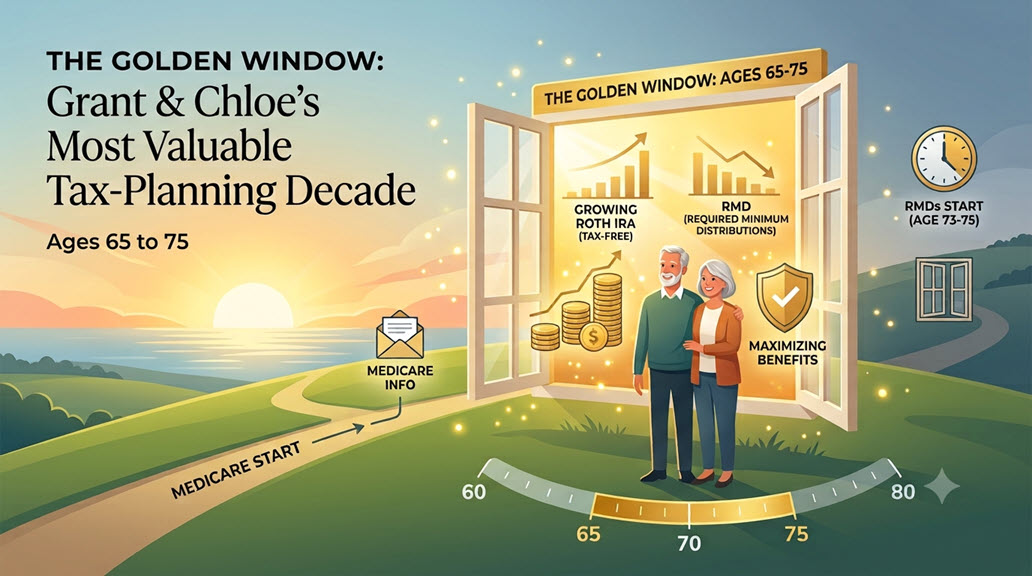
At Retirement “R” Us, we call this period The Golden Window.
-
When does it start? It typically begins when Medicare starts.
-
When does it end? It continues until Required Minimum Distributions (RMDs) eventually force taxable withdrawals from traditional retirement accounts.
For many retirees, this window lasts about ten years. It is often the single greatest opportunity to reduce lifetime taxes—and, unfortunately, it is also one of the most overlooked.
Retirement Is No Longer About This Year
Most people think about taxes one year at a time:
-
How much will I owe this April?
-
Can I lower my taxes before December 31?
Those are good questions, but retirement requires a much longer view.
Instead, imagine laying every future tax return side by side across the next 30 years. Now ask a different question:
How can we make the total taxes across all thirty years as small as possible?
That subtle shift changes everything. Sometimes the answer isn’t paying less tax today; sometimes it’s intentionally paying a little more today to avoid paying much more later. That’s exactly what Grant and Chloe are about to discover.
The Hidden Tax Time Bomb
Grant still has approximately $850,000 in traditional retirement accounts. While those savings have grown tax-deferred for decades, there’s one important detail many retirees overlook: The IRS hasn’t forgotten about them.
Think of a traditional IRA or 401(k) as a loan from the government:
-
Every contribution reduced taxable income during Grant’s working years.
-
Every dollar of investment growth accumulated without current taxation.
-
Eventually, however, the bill comes due.
The IRS doesn’t simply hope retirees withdraw the money—it requires it. These mandatory withdrawals are known as Required Minimum Distributions (RMDs).
Many retirees don’t think much about RMDs because they seem far away. That’s a mistake. By the time RMDs arrive, many planning opportunities have already disappeared.
The Snowball Effect
Imagine Grant does absolutely nothing for the next decade.
-
His retirement account continues growing.
-
Market returns compound.
-
The balance increases.
Eventually, RMDs begin. Suddenly, every year the IRS requires larger taxable withdrawals. Those mandatory distributions don’t exist in isolation; they stack on top of everything else Grant may also be receiving:
-
Social Security benefits
-
Pension income (if applicable)
-
Interest and dividends
-
Capital gains
-
Other investment income
Instead of controlling his taxable income, his taxable income begins controlling him. That’s the opposite of good retirement planning.
Retirement “R” Us Insight:
The best time to reduce future Required Minimum Distributions is years before they begin. Once the IRS starts forcing withdrawals, your flexibility becomes much more limited.
Introducing Roth Conversions
When many retirees hear the phrase “Roth conversion,” they immediately think, “That sounds complicated.” In reality, the concept is surprisingly simple.
Imagine Grant has two buckets:
-
Bucket 1 (Traditional IRA): Belongs partly to him and partly to the IRS.
-
Bucket 2 (Roth IRA): Belongs entirely to him.
A Roth conversion simply moves money from Bucket One into Bucket Two.
There’s one important catch: The amount converted becomes taxable income in the year of the conversion.
At first glance, that sounds like a terrible idea. Why would anyone voluntarily pay taxes? Because the goal isn’t to avoid taxes today—the goal is to avoid paying higher taxes later.
A Farmer’s Lesson
Imagine a farmer who knows a storm is coming. He has two choices:
-
Option A: Harvest a portion of his crops today while the weather is calm.
-
Option B: Wait until the storm arrives and risk losing much more.
Roth conversions work much the same way. Grant has an opportunity to “harvest” taxable income during years when his tax rate is relatively low. If he waits until RMDs force larger withdrawals, he may lose control over how much income appears on his tax return.
Planning ahead often means harvesting taxes under favorable conditions.
Why the Golden Window Is So Valuable
During Grant’s working years, his salary largely determined his tax bracket. During the Bridge Years, healthcare subsidies limited how much taxable income made sense.
Now, Medicare has begun. The Affordable Care Act subsidy concern has largely disappeared. Grant and Chloe still need income for living expenses, but they also have something incredibly valuable: Room.
-
Room inside lower tax brackets.
-
Room before future Required Minimum Distributions.
-
Room before larger Social Security taxation.
-
Room to reshape their retirement.
That’s the Golden Window.
Filling the Buckets Intentionally
Think about pouring water into a series of measuring cups. Each federal tax bracket represents another cup. Instead of accidentally overflowing into higher tax rates later, Grant and Chloe can intentionally fill today’s lower brackets.
Suppose they determine they can comfortably remain within a tax bracket they consider reasonable. They might decide to convert enough traditional IRA money each year to fill that bracket—but not spill unnecessarily into the next.
-
Every year, another portion of their traditional retirement account quietly moves into Roth.
-
Year after year, the taxable account shrinks.
-
The tax-free account grows.
-
Future RMDs become smaller.
-
Future flexibility becomes larger.
A Decade of Small Decisions
Many people imagine Roth conversions as one enormous transaction. They don’t have to be. In fact, smaller annual conversions often produce better long-term results.
Imagine Grant converts a portion of his traditional retirement account each year for ten years. No single conversion is dramatic, but together, they may move hundreds of thousands of dollars into a Roth environment. Each year’s decision builds on the last. Like compound interest, good tax planning compounds over time.
Retirement “R” Us Insight:
Successful retirement planning rarely depends on one brilliant decision. It usually comes from making dozens of smart decisions consistently over many years.
More Than Just Taxes
Reducing future Required Minimum Distributions creates benefits far beyond the tax return. One thoughtful strategy can solve multiple problems simultaneously, helping to:
-
Reduce future Medicare premium surcharges.
-
Keep more Social Security benefits from becoming taxable.
-
Preserve flexibility for large purchases later in retirement.
-
Create a larger pool of tax-free assets for emergencies.
-
Simplify retirement income planning.
Every decision echoes into future years, which is why retirement planning should never focus on one tax return in isolation.
The Power of Tax Diversification
Investment diversification is something most people understand: Don’t put everything into one stock, one industry, or one country. Tax diversification follows the same philosophy.
Instead of placing every retirement dollar into one tax category, Grant and Chloe gradually create balance:
[ Taxable Savings ] --> [ Partially Taxable ] --> [ Tax-Free (Roth) ]
Now, each year they can choose which bucket best fits their circumstances:
-
If they need extra income, they have options.
-
If tax laws change, they have options.
-
If healthcare expenses increase, they have options.
Flexibility becomes one of the greatest assets in retirement.
Planning for the Unexpected
No one knows exactly what tax rates will look like ten or twenty years from now. Congress changes tax laws. Healthcare costs change. Markets change. Life changes.
What Grant and Chloe can control is preparing for uncertainty. By gradually increasing their Roth savings, they’re building a reserve of tax-free income that can be used whenever flexibility matters most.
Think of it as buying insurance against future tax uncertainty. No one can predict tomorrow’s tax code, but everyone can prepare for it.
Looking Beyond Grant and Chloe
Retirement planning isn’t just about today’s retirees. Grant and Chloe have a young son. One day, the wealth they’ve spent decades building may become part of his inheritance.
The tax characteristics of those assets matter:
-
Traditional retirement accounts often carry heavy future tax obligations for heirs.
-
Roth assets generally offer beneficiaries far greater tax flexibility.
Every Roth conversion Grant and Chloe complete today may not only benefit their own retirement—it may also improve the legacy they eventually leave behind. That’s the power of thinking across generations rather than just across tax years.
The Golden Window Doesn’t Stay Open Forever
Eventually, the opportunity begins to narrow:
-
Required Minimum Distributions arrive.
-
Social Security benefits are fully underway.
-
Medicare premiums become more sensitive to income.
-
Flexibility decreases.
That’s why waiting can be costly. Every year that passes without a plan is one less year available for strategic action. The Golden Window doesn’t slam shut overnight, but year by year, it quietly becomes smaller. The retirees who recognize it early often enjoy far greater control over their financial future.
Coming Up in Part 4: The Legacy Years
Grant and Chloe have successfully navigated the Bridge Years. They’ve taken advantage of the Golden Window. Now comes the final chapter of retirement planning.
-
How do they manage Required Minimum Distributions without letting taxes spiral upward?
-
How can they reduce the tax burden on a surviving spouse?
-
When does charitable giving become one of the most tax-efficient financial tools available?
-
And perhaps most importantly, how do they ensure that the wealth they’ve spent a lifetime building continues to benefit their family instead of unnecessarily enriching the IRS?
In Part 4, we’ll bring together every piece of the Retirement Visibility Strategy™ and show how thoughtful planning today can create confidence, flexibility, and a lasting legacy for decades to come.
Important Disclosures: Retirement “R” Us, a registered retirement planning advisor, provides this information for educational purposes only. It is not intended to offer personalized investment advice or suggest that any discussed securities or services are suitable for any specific investor. Readers should not rely solely on the information provided here when making investment decisions.
- Investing carries risks, including the potential loss of principal. No investment strategy can ensure a profit or protect against loss during market downturns.
- Past performance is not indicative of future results.
- The opinions shared are not meant to serve as investment advice or to predict future performance.
- While we believe the information provided is reliable, we do not guarantee its accuracy or completeness.
- This content is for educational purposes only and is not intended as personalized advice or a guarantee of achieving specific results. Consult your tax and financial advisors before implementing any discussed strategies.
- Everyone’s retirement circumstances, especially when it comes to health insurance and health care, are unique.
- Retirement “R” Us does not provide tax or legal advice. Please consult your tax advisor or attorney for advice tailored to your situation.
Legal Disclaimer: The information provided on this website is for general informational purposes only and is not intended to be legal advice. While we strive to ensure the accuracy and completeness of the information, we make no guarantees regarding its accuracy, completeness, or timeliness. The content is provided “as is” without any warranties of any kind, either express or implied.
Use of this website does not create an attorney-client relationship between the user and the website owner or any of its contributors. Users should not act upon the information provided without seeking professional legal counsel. Any reliance on the information provided is solely at the user’s own risk.
We are not responsible for any errors or omissions, or for any actions taken based on the information provided on this website. Links to third-party websites are provided for convenience only and do not constitute an endorsement or approval of their content. We are not liable for any damages arising from the use of or reliance on the information provided on this website or any linked third-party websites.
By using this website, you agree to the terms of this legal disclaimer. If you do not agree with these terms, please do not use this website.
Leave a Reply