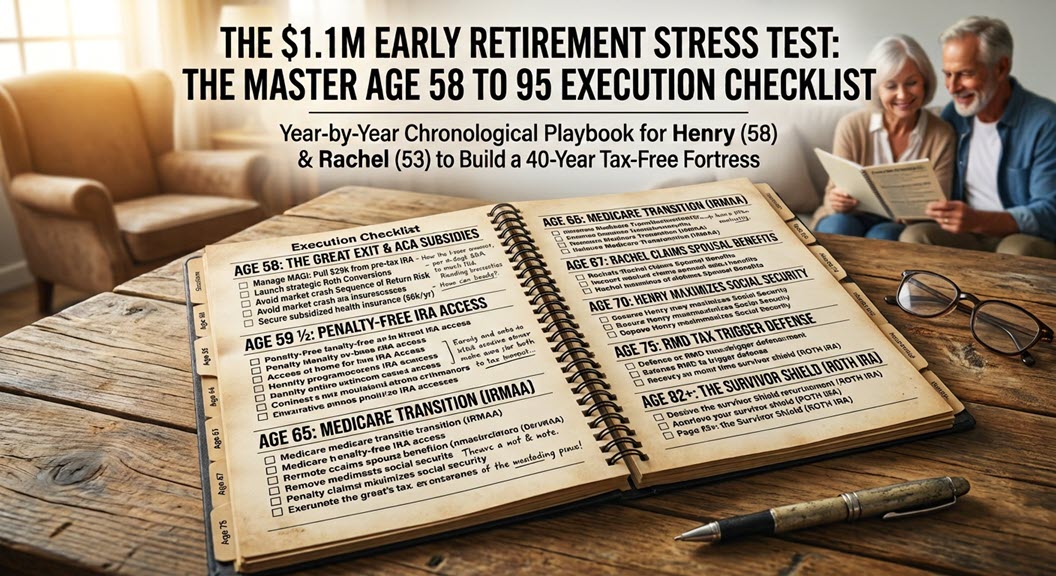
You have the theory. Now, you need the schedule. Here is the exact, year-by-year chronological playbook Henry and Rachel must follow to turn $1.1 million into a 40-year tax-free fortress.
📌 THE COLLINS FAMILY CASE STUDY ON RETIREMENT R US
Welcome to the Grand Finale! For the past nine weeks, we have dismantled traditional financial advice to build a mathematically bulletproof blueprint for readers in their 50s. We’ve watched Henry (55) and Rachel (50) optimize their $1.1 million portfolio to safely exit the workforce at age 58.
-
In Parts 1-4: We crushed the 4% Rule and built a $250k cash buffer to neutralize market crashes.
-
In Parts 5-6: We engineered “invisible income” to save $126k on health insurance and launched a 10-year Roth Conversion strike.
-
In Parts 7-9: We maximized Social Security, defused the Age 75 RMD tax bomb, and shielded Rachel from the Widow’s Tax Trap.
Today, we bring it all together. A financial plan is only as good as its execution. Bookmark this page, share it with your spouse, and use it as your ultimate retirement execution checklist.
The Core Philosophy: Control What You Can
The financial services industry wants you to obsess over the stock market—something you have zero control over.
The Retirement R Us methodology flips the script. We assume the market will crash. We assume inflation will spike. Instead of predicting the economy, we ruthlessly control the four things we actually have power over: Asset Liquidity, Tax Visibility, Healthcare Subsidies, and Claiming Timelines.
Before we dive into the chronological checklist, let’s look at how all these moving parts interact over the next 40 years.
The Master Timeline: Year-by-Year Execution
Here is the exact schedule Henry and Rachel will follow to execute their asymmetric retirement plan.
Age 58: The Great Exit & The Healthcare Cliff
Year 1
The Action: Henry officially retires. His $150,000 salary drops to zero.
The Strategy:
-
Engage the Cash Buffer: They begin pulling their $105,000 annual living budget primarily from their taxable brokerage account and cash reserves.
-
Manage MAGI: They pull exactly $29,000 from Henry’s pre-tax IRA to fill up their standard tax deduction.
-
Secure Subsidies: By keeping their visible income at $29,000, they stay well below the Affordable Care Act (ACA) cliff, instantly securing heavily subsidized health insurance for $6,000/year instead of paying the $24,000 retail price.
-
Launch Conversions: They use the remaining $55,600 of space under the ACA cliff to execute their first strategic Roth Conversion, paying a low 12% tax rate out-of-pocket.
Age 59 ½: The Penalty-Free Milestone
Year 2.5
The Action: Henry crosses the IRS age threshold for penalty-free retirement account access.
The Strategy:
-
The 10% early withdrawal penalty on Henry’s pre-tax IRA and 401(k) officially drops off.
-
They do not change their withdrawal strategy. They continue relying on their cash buffer to avoid Sequence of Return Risk if the market is down, and they continue their precise Roth conversions to hollow out the pre-tax accounts.
Age 65: The Medicare Transition
Year 8
The Action: Henry transitions off the ACA exchanges and onto Medicare.
The Strategy:
-
The Cliff Shifts: The dangerous ACA subsidy cliff vanishes, replaced by the much higher Medicare IRMAA cliff ($218,000 for married couples).
-
Accelerate Conversions: With the ACA limits gone, they widen their Roth conversion window, shifting up to $50,000 per year into their tax-free bucket without triggering any Medicare premium surcharges.
Age 67: Full Retirement Age (FRA)
Year 10
The Action: Henry and Rachel both reach their Full Retirement Age for Social Security.
The Strategy:
-
Rachel Claims: Rachel files for her spousal benefit, locking in 50% of Henry’s base amount ($22,500 per year). This provides a massive influx of guaranteed cash flow.
-
Henry Delays: Henry intentionally does not claim his benefit. He lets his base amount grow by 8% per year to maximize his payout and protect Rachel later in life.
-
Portfolio Relief: Because Rachel’s check is now covering a portion of their $105,000 living expenses, the pressure on their investment portfolio drops drastically.
Year 13
The Action: Henry claims his maximized, delayed Social Security benefit.
The Strategy:
-
The Income Floor is Set: Henry locks in his permanently increased benefit of $4,650 per month.
-
Withdrawal Rate Plummets: Combined with Rachel’s spousal benefit, the government is now paying them $78,300 per year. Their required portfolio withdrawal rate permanently drops to a hyper-safe 3.41%. The “bridge phase” is officially over.
Age 75: The RMD Tax Trigger
Year 18
The Action: Under the new rules enacted by the SECURE 2.0 Act, Henry is forced to begin taking Required Minimum Distributions (RMDs) from his pre-tax accounts [1].
The Strategy:
-
The Payoff: If they had done no planning, the IRS would force Henry to withdraw over $73,000 this year, stacking on top of their Social Security and pushing them into brutal tax brackets.
-
The Defense: Because they spent the last 17 years aggressively converting funds to their Roth IRA, Henry’s pre-tax balance is tiny. His RMD is slashed by over 60%, saving them over $14,000 in federal taxes this year alone and keeping them safely under the Medicare IRMAA surcharges.
Age 82+: The Survivor Phase
Year 25+
The Action: Statistically, one spouse will likely predecease the other during this window. (For our case study, we assume Henry passes away).
The Strategy:
-
The Widow’s Trap Sprung: Rachel is forced to file her taxes as a “Single” filer, slashing her standard deduction in half and compressing her tax brackets.
-
The Survivor Shield: Rachel steps into Henry’s maximized $4,650/month Social Security check, preserving her income floor.
-
The Tax-Free Fortress: When Rachel needs extra cash, she pulls it entirely from her massive Roth IRA. Because Roth withdrawals are 100% invisible to the IRS, she never triggers the punitive single-filer tax rates and never pays taxes on her Social Security. She lives the rest of her life in complete financial peace.
Final Thoughts: The Value of a Blueprint
A successful early retirement does not happen by accident. You cannot just pick a withdrawal rate, cross your fingers, and hope the stock market cooperates. You have to actively manipulate the tax code, defend against healthcare cliffs, and shield your spouse from the inevitable Widow’s Penalty.
If you are in your 50s and looking down the barrel of retirement, stop worrying about what the S&P 500 is going to do next week. Start looking at your asset location. Start looking at your visible income. And start building your bridge.
Thank you for joining us for this massive 10-part case study here on Retirementrus.com. If this series helped clarify your future, please bookmark this page, share it with a friend, and use it as your roadmap to financial independence!
Important Disclosures: Retirement “R” Us, a registered retirement planning advisor, provides this information for educational purposes only. It is not intended to offer personalized investment advice or suggest that any discussed securities or services are suitable for any specific investor. Readers should not rely solely on the information provided here when making investment decisions.
- Investing carries risks, including the potential loss of principal. No investment strategy can ensure a profit or protect against loss during market downturns.
- Past performance is not indicative of future results.
- The opinions shared are not meant to serve as investment advice or to predict future performance.
- While we believe the information provided is reliable, we do not guarantee its accuracy or completeness.
- This content is for educational purposes only and is not intended as personalized advice or a guarantee of achieving specific results. Consult your tax and financial advisors before implementing any discussed strategies.
- Everyone’s retirement circumstances, especially when it comes to health insurance and health care, are unique.
- Retirement “R” Us does not provide tax or legal advice. Please consult your tax advisor or attorney for advice tailored to your situation.
Legal Disclaimer: The information provided on this website is for general informational purposes only and is not intended to be legal advice. While we strive to ensure the accuracy and completeness of the information, we make no guarantees regarding its accuracy, completeness, or timeliness. The content is provided “as is” without any warranties of any kind, either express or implied.
Use of this website does not create an attorney-client relationship between the user and the website owner or any of its contributors. Users should not act upon the information provided without seeking professional legal counsel. Any reliance on the information provided is solely at the user’s own risk.
We are not responsible for any errors or omissions, or for any actions taken based on the information provided on this website. Links to third-party websites are provided for convenience only and do not constitute an endorsement or approval of their content. We are not liable for any damages arising from the use of or reliance on the information provided on this website or any linked third-party websites.
By using this website, you agree to the terms of this legal disclaimer. If you do not agree with these terms, please do not use this website.

Leave a Reply