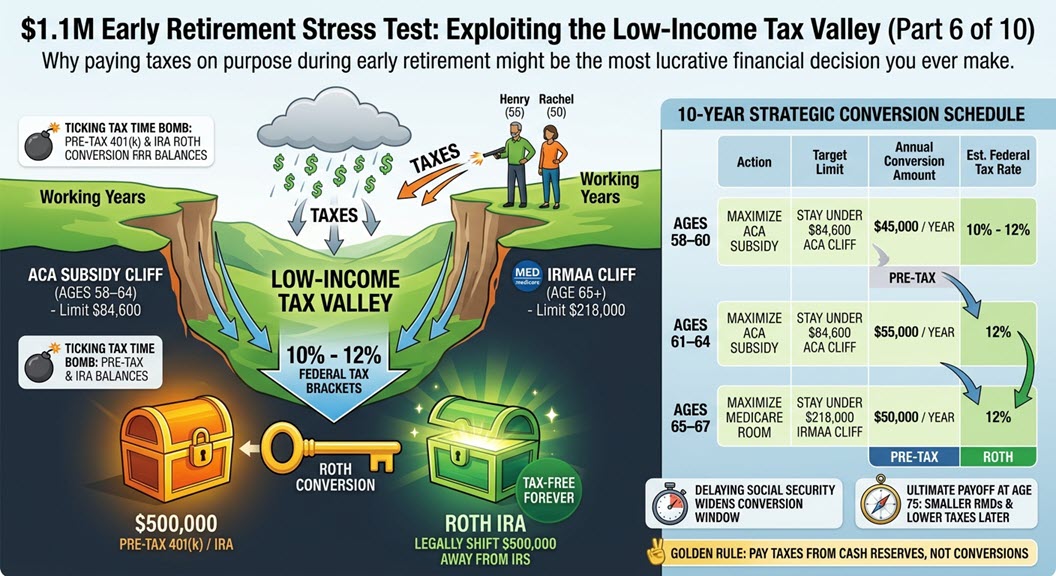
Why paying taxes on purpose during early retirement might be the most lucrative financial decision you ever make. We reveal how to legally shift $500,000 away from the IRS using the Roth Conversion Window.

📌 THE COLLINS FAMILY CASE STUDY ON RETIREMENT R US

Welcome back to our 10-part early retirement masterclass! We are mapping a bulletproof retirement blueprint for Henry (55) and Rachel (50), executing a strategy to retire at 58 with a $1.1 million portfolio.
  • In Parts 1 & 2, we dismantled the 4% Rule and built their baseline.
  • In Parts 3 & 4, we neutralized market crashes and Sequence of Return Risk using a cash buffer.
  • In Part 5, we saved $126,000 on health insurance by manipulating “Visible Income” to qualify for massive Affordable Care Act (ACA) subsidies.
Today, we take the exact same visibility mechanics we used to save money on healthcare and use them to launch an offensive strike against the IRS. It is time to exploit the Low-Income Tax Valley.

The Ticking Tax Time Bomb

To understand the strategy we are about to deploy, we have to face a harsh reality about Henry’s $500,000 pre-tax 401(k) and IRA balance.
That money does not fully belong to Henry and Rachel. The IRS owns a significant percentage of it. Because Henry received a tax deduction when he contributed that money during his working years, every single dollar pulled out of that account in retirement will be taxed as ordinary income.
Worse, the IRS will not let that money sit there forever. Eventually, the government forces money out of your pre-tax accounts through Required Minimum Distributions (RMDs), whether you actually need the cash to live on or not.
So, the question isn’t whether that money is coming out of the accounts. The real question is whether it will come out strategically on Henry and Rachel’s terms, keeping their tax rates low, or reactively on the government’s terms later in life, triggering a cascade of high taxes.

Entering the “Low-Income Valley”

When Henry retires at age 58, his $150,000 salary drops to zero. Because he is delaying Social Security, he has no guaranteed earned income hitting his tax return.
For the Collins family, this phase creates something incredibly valuable: a low-income valley. Their reported income is suddenly lower than it was while they were working, and crucially, it is lower than it will be later in life once Social Security and forced RMDs kick in.
Right now, Henry and Rachel are sitting comfortably in the 10% or 12% federal tax brackets—a historically low rate they may never see again once the government starts forcing distributions.
This valley is the perfect environment for a Roth Conversion.
A Roth conversion is the process of taking money out of a pre-tax IRA, paying the income taxes on it today, and moving it into a Roth IRA where it will grow 100% tax-free forever. They are choosing to intentionally pay taxes at a 12% rate today, instead of being forced to pay at a 22% or 24% rate later in retirement.

The Master-Level Balancing Act: ACA Subsidies vs. Roth Conversions

Here is where standard financial advice usually falls apart.
In Part 5, we engineered a strategy to keep Henry and Rachel’s Modified Adjusted Gross Income (MAGI) at exactly $29,000. By keeping their visible income this low, they stayed safely under the ACA healthcare cliff, securing $18,000 a year in health insurance subsidies.
But a Roth conversion creates visible income. Every dollar converted is added to their MAGI. If they convert too much, they will accidentally cross the ACA cliff, lose their subsidies, and trigger a $24,000 health insurance bill.
So, how do we convert money without blowing up their healthcare?
In 2026, the ACA subsidy cliff is set at 400% of the Federal Poverty Line, which lands at roughly $84,600. If Henry and Rachel go even $1 over that line, their subsidies vanish.
Let’s do the math:
  • Current Visible MAGI: $29,000 (from their strategic living expense withdrawals).
  • The ACA Cliff: $84,600.
  • Available Conversion Room: $84,600 – $29,000 = $55,600.
This means Henry and Rachel can legally convert up to $55,000 per year into a Roth IRA during their 50s and early 60s, pay taxes at the ultra-low 12% bracket, and still keep 100% of their ACA health insurance subsidies!

Phase 2: The Medicare IRMAA Cliff

The strategy shifts into overdrive when Henry and Rachel reach Phase 2 of retirement, which spans roughly age 65 to 75.
At age 65, Henry transitions onto Medicare. The ACA healthcare cliff completely disappears, replacing the $84,600 limit with a new, much higher threshold: The Medicare IRMAA (Income-Related Monthly Adjustment Amount) cliff.
For a married couple filing jointly, the standard Medicare premium threshold allows for an income up to $218,000 before surcharges apply. If your income crosses that line to just $218,001, Medicare premiums can suddenly jump by thousands of dollars per year.
However, because Henry and Rachel only need $105,000 to cover their spending, they will stay well under the $218,000 Medicare cliff. Even if they were pulling a full $100,000 from their IRA to live on, they would still have over $118,000 of room under the Medicare cliff to execute Roth conversions.
Because they have all that room, they can easily move tens of thousands of dollars into a Roth each year without ever triggering a penalty. Furthermore, by delaying Social Security claims, they prevent that income from taking up room in their low-income valley, meaningfully widening their conversion window.

The 10-Year Strategic Conversion Schedule

By merging the ACA limits (Ages 58–64) with the Medicare IRMAA limits (Ages 65–67), we can build a highly precise, 10-year conversion roadmap for the Collins family.
Age Window Action Target Limit Annual Conversion Amount Est. Federal Tax Rate
Ages 58–60 Maximize ACA Subsidy Stay Under $84,600 ACA Cliff $45,000 / year 10% – 12%
Ages 61–64 Maximize ACA Subsidy Stay Under $84,600 ACA Cliff $55,000 / year 12%
Ages 65–67 Maximize Medicare Room Stay Under $218,000 IRMAA Cliff $50,000 / year 12%

The Total Impact

Over this 10-year window, Henry and Rachel will systematically shift $505,000 out of their heavily taxed pre-tax accounts and permanently lock it inside a tax-free Roth IRA.
The Golden Rule of Conversions: To maximize the mathematical power of this strategy, Henry and Rachel will not withhold taxes from the conversions themselves. Instead, they will pay the estimated $4,100 to $5,400 annual tax bills using their cash reserves or taxable brokerage account. This allows the full $505,000 to enter the Roth bucket, compounding 100% tax-free for the next 30 years.

The Ultimate Payoff at Age 75

Why go through all this effort to pay taxes early?
Because by knowing where the cliffs are and using this low-income valley to convert, they lock in lower tax rates now and protect themselves from higher ones later.
When Henry reaches age 75, the IRS will finally force him to take Required Minimum Distributions. But because they executed this 10-year strategy, the balance of his pre-tax IRA has been fundamentally hollowed out.
The more money they moved into a Roth before RMDs kicked in, the smaller those required distributions are. Smaller RMDs mean less forced visibility, lower overall tax brackets later in life, and drastically less risk of crossing Medicare cliffs in their 80s and 90s.
They have successfully insulated their wealth from the government.
Coming Up Next Week in Part 7…
We mentioned earlier that delaying Social Security opens up more room for Roth Conversions, but when is the absolute best time to claim it?
Next week, we are running the break-even math on Social Security. We will compare claiming at 62, 67, and 70 to reveal why optimizing these benefits is about much more than just a monthly payout—it is the ultimate defense mechanism for surviving spouses.

Important Disclosures:  Retirement “R” Us, a registered retirement planning advisor, provides this information for educational purposes only. It is not intended to offer personalized investment advice or suggest that any discussed securities or services are suitable for any specific investor. Readers should not rely solely on the information provided here when making investment decisions.

  • Investing carries risks, including the potential loss of principal. No investment strategy can ensure a profit or protect against loss during market downturns.
  • Past performance is not indicative of future results.
  • The opinions shared are not meant to serve as investment advice or to predict future performance.
  • While we believe the information provided is reliable, we do not guarantee its accuracy or completeness.
  • This content is for educational purposes only and is not intended as personalized advice or a guarantee of achieving specific results. Consult your tax and financial advisors before implementing any discussed strategies.
  • Everyone’s retirement circumstances, especially when it comes to health insurance and health care, are unique.
  • Retirement “R” Us does not provide tax or legal advice. Please consult your tax advisor or attorney for advice tailored to your situation.

Legal Disclaimer:  The information provided on this website is for general informational purposes only and is not intended to be legal advice. While we strive to ensure the accuracy and completeness of the information, we make no guarantees regarding its accuracy, completeness, or timeliness. The content is provided “as is” without any warranties of any kind, either express or implied.

Use of this website does not create an attorney-client relationship between the user and the website owner or any of its contributors. Users should not act upon the information provided without seeking professional legal counsel. Any reliance on the information provided is solely at the user’s own risk.

We are not responsible for any errors or omissions, or for any actions taken based on the information provided on this website. Links to third-party websites are provided for convenience only and do not constitute an endorsement or approval of their content. We are not liable for any damages arising from the use of or reliance on the information provided on this website or any linked third-party websites.

By using this website, you agree to the terms of this legal disclaimer. If you do not agree with these terms, please do not use this website.


Leave a Reply

Your email address will not be published. Required fields are marked *