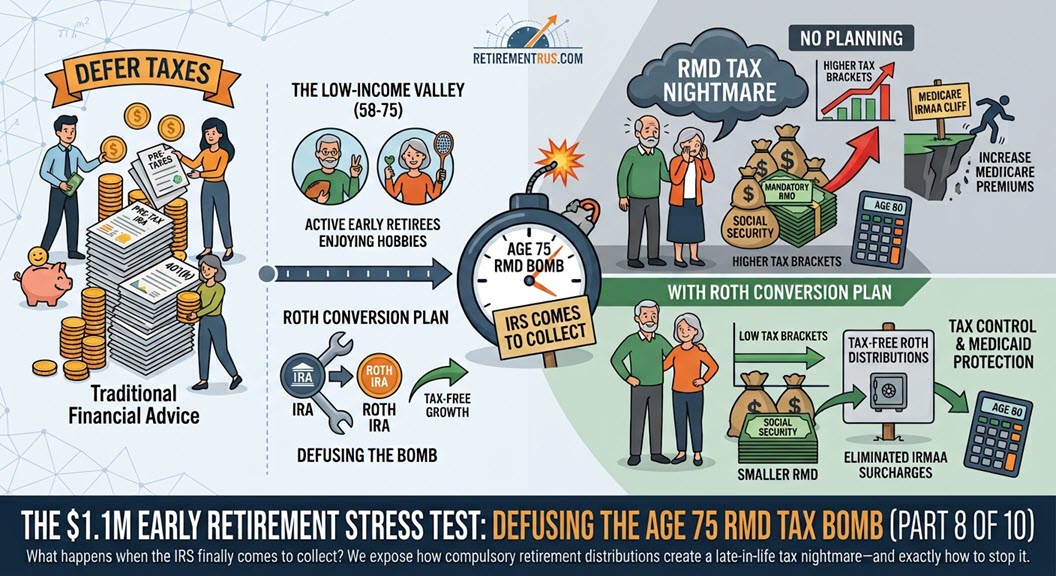
What happens when the IRS finally comes to collect? We expose how compulsory retirement distributions create a late-in-life tax nightmare—and exactly how to stop it.

📌 THE COLLINS FAMILY CASE STUDY ON RETIREMENT R US

Welcome back to week 8 of our flagship early retirement series here on Retirementrus.com! We are charting a mathematically bulletproof blueprint for Henry (55) and Rachel (50) to exit the workforce at 58 with a $1.1 million portfolio.
  • In Parts 1 & 2: We built their balance sheet and exposed the flaws of the traditional 4% Rule.
  • In Parts 3 & 4: We neutralized market crashes using a $250k cash buffer.
  • In Part 5: We saved $126,000 in pre-Medicare health insurance by managing “visible income.”
  • In Part 6: We launched a 10-year Roth Conversion strike against the IRS.
  • In Part 7: We proved why delaying Social Security to age 70 is the ultimate survivor protection.
Today, we jump forward in time. Henry is about to celebrate his 75th birthday. He has survived the bridge phase, he has maximized his Social Security, and his portfolio has grown. But a massive, unavoidable tax trap is ticking right beneath his feet.

The Compulsory Distribution Trap

For decades, the standard financial advice has been simple: defer your taxes. Put as much money as possible into your Traditional 401(k) or Pre-Tax IRA, claim the tax deduction today, and let the money compound tax-deferred for the rest of your working life.
It sounds like a perfect deal—until you realize that the IRS is incredibly patient, but they are not generous. They want their cut, and they eventually force you to pay up.
Under the SECURE 2.0 Act, the government mandates that retirees must begin withdrawing a specific percentage of their pre-tax retirement accounts starting at age 75[cite: 2]. These are called Required Minimum Distributions (RMDs)[cite: 2].
Here is the terrifying part about RMDs: The IRS does not care if you actually need the money to live on.
They force you to pull that cash out of your tax-sheltered accounts and add it directly to your visible taxable income for that year[cite: 1]. If you refuse to take the distribution, or if you miscalculate the amount, the IRS levies a severe tax penalty on the money you failed to withdraw.

The Stacking Effect: A Recipe for Bracket Creep

To understand why RMDs are so dangerous for the Collins family, you have to look at their income structure at age 75.
If Henry delayed his Social Security to age 70 (as we mapped out in Part 7), he and Rachel are now receiving a combined $78,300 per year in guaranteed, inflation-protected income. That provides a fantastic financial floor. But it also means that the foundation of their tax return is already elevated.
When Henry’s RMDs kick in at age 75, that mandatory withdrawal doesn’t just sit in a vacuum. It stacks directly on top of their Social Security income.
If Henry had done zero tax planning during his 50s and 60s, his $500,000 pre-tax IRA would have sat untouched, compounding for nearly two decades. By age 75, assuming standard market growth, that pre-tax IRA would have swelled to roughly $1,800,000.
Using the IRS Uniform Lifetime Table, a $1.8 million balance at age 75 triggers a mandatory first-year RMD of $73,170.
Let’s do the math on the stacking effect:
  • Social Security Income: $78,300
  • Mandatory RMD: $73,170
  • Total Visible Income Forced Onto the Tax Return: $151,470
Henry and Rachel only need $105,000 to live comfortably. But the IRS is forcing them to realize over $151,000 in income, pushing tens of thousands of dollars into much higher, more punitive federal tax brackets.

The Hidden Surcharge: The Medicare IRMAA Cliff

Income taxes are only half the battle. When the government forces visibility onto your tax return, it triggers a domino effect that hits your healthcare costs.
In Part 5, we discussed the Affordable Care Act (ACA) subsidy cliff that early retirees face in their 60s[cite: 1]. But once retirees hit age 65, they transition to Medicare, which introduces an entirely new cliff: IRMAA (Income-Related Monthly Adjustment Amount)[cite: 1].
IRMAA is a stealth surcharge that increases your Medicare Part B and Part D premiums if your visible income crosses specific thresholds[cite: 1]. For married couples filing jointly in 2026, the base tier allows for an income of up to $218,000 before surcharges apply[cite: 3]. If your income crosses that threshold by even a single dollar, your Medicare premiums can suddenly jump by thousands of dollars per year[cite: 1].
While Henry and Rachel’s unmanaged $151,470 income keeps them under the initial IRMAA cliff at age 75, their RMDs will systematically grow every single year as they age[cite: 1].
By the time Henry is 85, an unmanaged $1.75 million IRA balance triggers an RMD of $109,375. Stacked on top of their inflation-adjusted Social Security, their visible income will begin flirting with IRMAA boundaries, risking massive healthcare surcharges at the exact stage of life when their medical needs are highest[cite: 1].

The Roth Conversion Rescue: Math in Action

Thankfully, Henry and Rachel do not have to accept this fate. Because they followed our blueprint, they already defused this tax bomb.
In Part 6, we exploited their “Low-Income Valley” to systematically convert $505,000 from Henry’s pre-tax IRA into a tax-free Roth IRA over 10 years[cite: 1].
Because they moved that money before age 75, the capital grew inside the Roth bucket—100% immune from RMDs[cite: 1]. The pre-tax IRA, meanwhile, was systematically hollowed out.
Let’s look at the side-by-side comparison of what happens at age 75, age 80, and age 85, contrasting a “Do Nothing” strategy versus their “Roth Conversion” strategy.
Age No-Conversion IRA Balance No-Conversion Mandatory RMD No-Conversion Est. Federal Tax With-Conversion IRA Balance With-Conversion Mandatory RMD With-Conversion Est. Federal Tax
Age 75 $1,800,000 $73,170 $16,800 $600,000 $24,390 $6,800
Age 80 $1,950,000 $96,534 $23,400 $620,000 $30,693 $9,100
Age 85 $1,750,000 $109,375 $28,600 $500,000 $31,250 $10,800

The Staggering Financial Payoff

Look closely at the math at Age 80.
If Henry and Rachel had done nothing, the IRS would force them to withdraw nearly $100,000 from their IRA, hitting them with an estimated federal tax bill of $23,400.
Because they executed the 10-year Roth Conversion plan, their mandatory RMD is slashed to just $30,693. Their estimated federal tax bill plummets to $9,100.
That is an annual tax savings of over $14,300.
More importantly, this strategy completely eliminates the risk of Medicare IRMAA surcharges[cite: 1]. Because their RMDs are suppressed, their visible income remains permanently low[cite: 1]. If they need more cash to fund a kitchen remodel, buy a new car, or pay for long-term care, they simply pull the money from their heavily funded Roth IRA. That withdrawal is 100% invisible to the government, meaning it never touches their tax brackets or Medicare premiums[cite: 1].
They have successfully wrested control of their wealth away from the IRS.
Coming Up Next Week in Part 9…
We have protected Henry and Rachel’s portfolio from market crashes, healthcare cliffs, and RMD tax bombs. But there is one devastating financial event that almost no one plans for until it is too late.
What happens to the tax brackets when one spouse passes away?
Next week, we are diving deep into the Widow’s Tax Trap—the cruel reality where the surviving spouse’s income barely changes, but their tax bill suddenly skyrockets. You won’t want to miss how the invisible Roth money we built today becomes the ultimate safety net tomorrow.

Important Disclosures:  Retirement “R” Us, a registered retirement planning advisor, provides this information for educational purposes only. It is not intended to offer personalized investment advice or suggest that any discussed securities or services are suitable for any specific investor. Readers should not rely solely on the information provided here when making investment decisions.

  • Investing carries risks, including the potential loss of principal. No investment strategy can ensure a profit or protect against loss during market downturns.
  • Past performance is not indicative of future results.
  • The opinions shared are not meant to serve as investment advice or to predict future performance.
  • While we believe the information provided is reliable, we do not guarantee its accuracy or completeness.
  • This content is for educational purposes only and is not intended as personalized advice or a guarantee of achieving specific results. Consult your tax and financial advisors before implementing any discussed strategies.
  • Everyone’s retirement circumstances, especially when it comes to health insurance and health care, are unique.
  • Retirement “R” Us does not provide tax or legal advice. Please consult your tax advisor or attorney for advice tailored to your situation.

Legal Disclaimer:  The information provided on this website is for general informational purposes only and is not intended to be legal advice. While we strive to ensure the accuracy and completeness of the information, we make no guarantees regarding its accuracy, completeness, or timeliness. The content is provided “as is” without any warranties of any kind, either express or implied.

Use of this website does not create an attorney-client relationship between the user and the website owner or any of its contributors. Users should not act upon the information provided without seeking professional legal counsel. Any reliance on the information provided is solely at the user’s own risk.

We are not responsible for any errors or omissions, or for any actions taken based on the information provided on this website. Links to third-party websites are provided for convenience only and do not constitute an endorsement or approval of their content. We are not liable for any damages arising from the use of or reliance on the information provided on this website or any linked third-party websites.

By using this website, you agree to the terms of this legal disclaimer. If you do not agree with these terms, please do not use this website.


Leave a Reply

Your email address will not be published. Required fields are marked *