
Most people assume retirement success depends on reaching some magic number like $2 million or $3 million. But retirement isn’t simply about accumulating wealth. It is about converting decades of savings into sustainable income while minimizing taxes, managing healthcare costs, and preserving flexibility for the next 30 years.
Let’s look at the case of Bobby Knight, a 56-year-old Senior Network Engineer from Los Angeles, and how proper planning may allow him to retire comfortably at age 60.
Meet Bobby
Bobby Knight is a 56-year-old Senior Network Engineer living in Los Angeles, California. He plans to retire at age 60 and estimates he will need approximately $85,000 annually to support his lifestyle.
He currently earns $160,000 per year and owns his home outright.
Current Balance Sheet
| Assets | Value |
|---|---|
| 401(k) | $525,000 |
| Traditional IRA | $75,000 |
| Roth IRA | $150,000 |
| Taxable Brokerage | $400,000 |
| Cash | $50,000 |
| Home Value | $450,000 |
| Total Investable Assets | $1,200,000 |
Estimated Social Security benefit at age 67:
$3,750 per month
or approximately
$45,000 annually
Why Bobby Is In Better Shape Than He Thinks
Bobby has several strengths working in his favor.
He Owns His Home Free and Clear
Without a mortgage payment, his fixed expenses are lower and he has greater flexibility during market downturns.
He Has Multiple Tax Buckets
His wealth is diversified among:
- Tax-deferred accounts
- Roth accounts
- Taxable investments
- Cash reserves
This gives him tremendous flexibility when generating retirement income.
Social Security Provides a Strong Foundation
His estimated Social Security benefit at age 67 will cover more than half of his desired spending.
His Taxable Brokerage Account Creates Flexibility
The $400,000 brokerage account can act as a bridge between retirement and Social Security while providing opportunities for tax planning.
At first glance, Bobby appears financially prepared for retirement.
But the greatest opportunities ahead are no longer investment-related.
They’re tax-related.
Retirement itself can be divided into three distinct chapters, each with its own opportunities and risks.
Phase One: Ages 60-65
The ACA Opportunity Years
One of the most overlooked periods in retirement occurs between leaving work and becoming eligible for Medicare.
For Bobby, these five years may become the most valuable tax-planning years of his life.
After retiring at age 60, Bobby loses employer health insurance but will not qualify for Medicare until age 65.
Fortunately, the Affordable Care Act (ACA) marketplace can provide substantial premium subsidies if income is carefully managed.
Spending and Income Are Not the Same Thing
Suppose Bobby needs:
$85,000 annually
That does not necessarily mean he needs to report $85,000 of taxable income.
Different sources of money create different tax consequences.
| Source | Taxable? |
|---|---|
| Traditional IRA | Fully taxable |
| 401(k) Withdrawal | Fully taxable |
| Roth IRA Withdrawal | Tax-free |
| Brokerage Principal | Tax-free |
| Cash Savings | Tax-free |
| Long-Term Capital Gains | Favorable tax treatment |
A Poor Withdrawal Strategy
Suppose Bobby withdraws the entire $85,000 from his IRA.
Taxable income:
$85,000
Consequences:
- Higher healthcare premiums
- Larger tax bill
- Reduced opportunities for Roth conversions
A Better Strategy
Suppose Bobby needs the same $85,000.
Income sources could look like this:
- IRA withdrawal: $30,000
- Brokerage account: $40,000
- Cash reserves: $15,000
Taxable income might only be:
$40,000 to $50,000
instead of $85,000.
This could result in:
✔ Lower taxes
✔ Lower healthcare costs
✔ Greater flexibility
Why ACA Subsidies Matter
Health insurance before Medicare can easily cost:
$12,000 to $18,000 annually
But properly managing income may reduce those costs significantly.
Potential savings:
$5,000 to $15,000 per year
Over five years, that could mean:
$25,000 to $75,000
in healthcare savings.
The Roth Conversion Opportunity
Retirement creates a low-tax valley.
Because Bobby’s earned income disappears, he may have room to strategically convert portions of his retirement accounts into Roth accounts.
Suppose he converts:
$40,000 annually
for five years.
Total converted:
$200,000
Benefits include:
- Smaller future RMDs
- More tax-free assets
- Reduced lifetime taxes
- Greater flexibility later
Phase One Objectives
Ages 60-65
Primary Goals:
- Manage healthcare costs
- Preserve ACA subsidies
- Begin Roth conversions
Primary Income Sources:
- Brokerage account
- Cash reserves
- Partial IRA withdrawals
- Strategic Roth conversions
Phase Two: Ages 65-74
The Golden Tax Window
At age 65, Bobby enrolls in Medicare.
Healthcare concerns become less important, but another opportunity emerges.
These years are often the most powerful tax-planning years of retirement.
Why?
Because:
- No required minimum distributions yet
- Income remains relatively low
- Tax brackets are favorable
- Bobby controls how much income to recognize
Should Bobby Delay Social Security?
Social Security at age 67:
$45,000 annually
Waiting until age 70 increases benefits approximately 24%.
Estimated age-70 benefit:
$56,000 annually
Advantages include:
- Larger guaranteed income
- Inflation protection
- Longevity insurance
- Reduced portfolio withdrawals later
Medicare IRMAA
One of the hidden taxes in retirement is IRMAA.
Higher income can increase Medicare premiums.
Crossing certain income thresholds can cause monthly premiums to rise substantially.
The objective isn’t necessarily to avoid every threshold.
The objective is to avoid accidentally creating unnecessary premium increases.
Continuing Roth Conversions
Suppose Bobby converts:
$50,000 annually
for eight years.
Total converted:
$400,000
Instead of allowing future RMDs to dictate his taxes, Bobby takes control.
Phase Two Objectives
Ages 65-74
Primary Goals:
- Fill lower tax brackets intentionally
- Delay Social Security if appropriate
- Reduce future RMDs
Primary Income Sources:
- Brokerage assets
- IRA withdrawals
- Roth conversions
- Social Security
Phase Three: Age 75 and Beyond
When the IRS Joins the Conversation
Eventually, the IRS begins requiring withdrawals from traditional retirement accounts.
These are called Required Minimum Distributions (RMDs).
Whether Bobby needs the money or not, they are taxable.
Suppose his tax-deferred accounts have grown to:
$1.2 million
First-year RMD:
Approximately
$50,000
If Social Security is paying:
$56,000 annually
Then taxable income may exceed:
$100,000
even if Bobby only spends $85,000.
The IRS taxes income, not spending.
Why Earlier Roth Conversions Matter
Suppose Bobby moved $500,000 into Roth accounts during the first two phases.
His IRA balance may now be:
$700,000
instead of $1.2 million.
Future RMDs become much smaller.
This may lower:
- Taxes
- Medicare premiums
- Social Security taxation
Qualified Charitable Distributions
Beginning at age 70½, Bobby may donate directly from his IRA.
Example:
RMD:
$40,000
Charitable giving:
$15,000
Taxable income becomes:
$25,000
instead of $40,000.
Benefits:
- Lower taxes
- Reduced Medicare premiums
- Satisfies RMD requirements
Four Risks That Could Derail Retirement
Sequence of Returns Risk
Retiring into a bear market can permanently damage a portfolio.
Maintaining two to three years of spending in cash and short-term bonds helps avoid selling investments during downturns.
Recommended reserve:
$170,000 to $250,000
Inflation Risk
Assuming 3% inflation:
| Age | Spending Equivalent |
|---|---|
| 60 | $85,000 |
| 70 | $114,000 |
| 80 | $153,000 |
| 90 | $206,000 |
Growth investments remain essential even during retirement.
Large Future RMDs
Without planning, Bobby’s retirement accounts could produce large taxable distributions.
Strategic Roth conversions help reduce this risk.
California Taxes
California taxes IRA withdrawals as ordinary income.
Reducing future tax-deferred balances may produce significant lifetime tax savings.
Putting It All Together
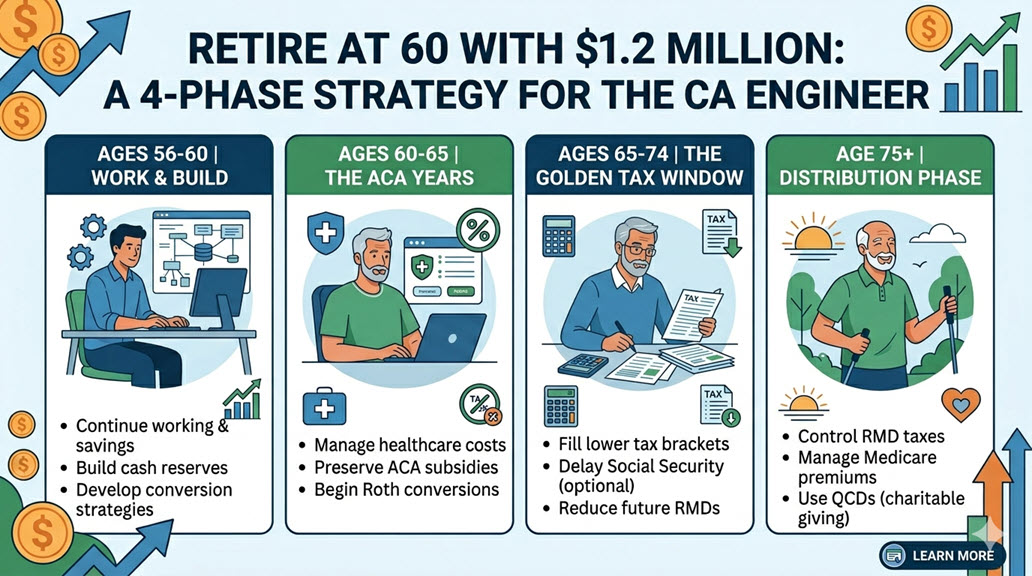
Bobby’s Retirement Timeline
Ages 56-60
Continue working.
Increase savings.
Build cash reserves.
Develop Roth conversion strategies.
Ages 60-65
The ACA Years
Income Sources:
- Brokerage account
- Cash reserves
- Partial IRA withdrawals
Objectives:
- Manage healthcare costs
- Preserve ACA subsidies
- Begin Roth conversions
Ages 65-74
The Golden Tax Window
Income Sources:
- Brokerage assets
- IRA withdrawals
- Delayed Social Security
- Continued Roth conversions
Objectives:
- Fill lower tax brackets
- Reduce future RMDs
- Manage Medicare premiums
Age 75+
Distribution Phase
Income Sources:
- Social Security
- Required Minimum Distributions
- Roth accounts
Objectives:
- Control taxes
- Manage Medicare premiums
- Use QCDs when appropriate
Final Thoughts
Bobby’s story illustrates an important truth about retirement.
Retirement isn’t one event.
It’s a series of seasons.
The challenges change over time.
In the early years, healthcare and ACA subsidies matter.
Later, Roth conversions and Social Security become the focus.
Eventually, Required Minimum Distributions and Medicare premiums take center stage.
Successful retirees don’t necessarily have the largest portfolios.
They simply understand how to coordinate taxes, income sources, Social Security, investments, and healthcare throughout each phase of retirement.
For Bobby, the greatest opportunity isn’t earning another percentage point of return.
It’s making sure every dollar he has already accumulated works as efficiently as possible.
Important Disclosures: Retirement “R” Us, a registered retirement planning advisor, provides this information for educational purposes only. It is not intended to offer personalized investment advice or suggest that any discussed securities or services are suitable for any specific investor. Readers should not rely solely on the information provided here when making investment decisions.
- Investing carries risks, including the potential loss of principal. No investment strategy can ensure a profit or protect against loss during market downturns.
- Past performance is not indicative of future results.
- The opinions shared are not meant to serve as investment advice or to predict future performance.
- While we believe the information provided is reliable, we do not guarantee its accuracy or completeness.
- This content is for educational purposes only and is not intended as personalized advice or a guarantee of achieving specific results. Consult your tax and financial advisors before implementing any discussed strategies.
- Everyone’s retirement circumstances, especially when it comes to health insurance and health care, are unique.
- Retirement “R” Us does not provide tax or legal advice. Please consult your tax advisor or attorney for advice tailored to your situation.
Legal Disclaimer: The information provided on this website is for general informational purposes only and is not intended to be legal advice. While we strive to ensure the accuracy and completeness of the information, we make no guarantees regarding its accuracy, completeness, or timeliness. The content is provided “as is” without any warranties of any kind, either express or implied.
Use of this website does not create an attorney-client relationship between the user and the website owner or any of its contributors. Users should not act upon the information provided without seeking professional legal counsel. Any reliance on the information provided is solely at the user’s own risk.
We are not responsible for any errors or omissions, or for any actions taken based on the information provided on this website. Links to third-party websites are provided for convenience only and do not constitute an endorsement or approval of their content. We are not liable for any damages arising from the use of or reliance on the information provided on this website or any linked third-party websites.
By using this website, you agree to the terms of this legal disclaimer. If you do not agree with these terms, please do not use this website.
Leave a Reply