
How an invisible income strategy and understanding the difference between a “Tax Cliff” and a “Tax Mile Marker” can save early retirees over $18,000 a year on health insurance.
📌 THE COLLINS FAMILY CASE STUDY ON RETIREMENT R US
Welcome back to our 10-part early retirement masterclass on Retirementrus.com! We are building a step-by-step blueprint for Henry (55) and Rachel (50) to exit the workforce at age 58 with a $1.1 million portfolio.
In Part 1 & 2, we built the balance sheet and debunked the 4% Rule.
In Part 3, we ran a 10,000-scenario Monte Carlo stress test.
In Part 4, we neutralized Sequence of Return Risk using a dedicated cash buffer.
Today, we are tackling the single most terrifying expense for anyone retiring in their 50s: The Pre-Medicare Health Insurance Gap.
Phase 1 of Retirement: The 7-Year Healthcare Desert
When Henry turns in his retirement paperwork at age 58, his family faces an immediate crisis. Medicare eligibility does not begin until age 65. That leaves Henry and Rachel wandering through a 7-year healthcare desert.
For most early retirees, the default instinct is to rely on COBRA. But when you retire before 65, most companies only offer continuation of health insurance for 18 months, and it can be incredibly expensive[cite: 1]. For a family of three in California, COBRA premiums can easily exceed $2,000 to $2,500 per month.
When COBRA runs out (or if it is too expensive to take in the first place), the next logical step is to go to Healthcare.gov to purchase an individual plan on the Affordable Care Act (ACA) Marketplace[cite: 1].
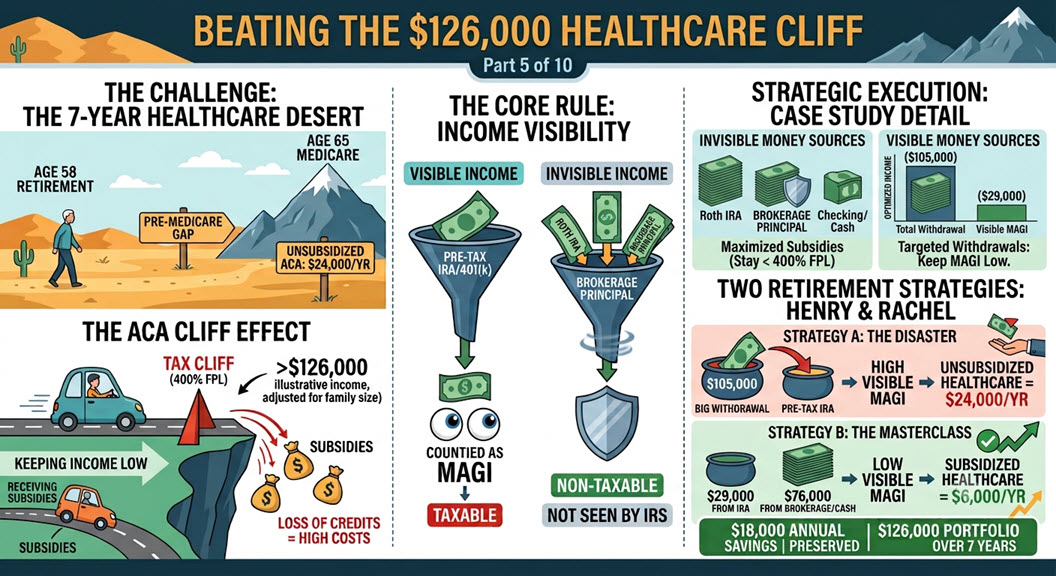
Without careful planning, an unsubsidized Silver or Gold ACA plan for Henry, Rachel, and their 9-year-old child will easily cost $24,000 a year out-of-pocket. That would consume nearly 25% of their target $105,000 annual living budget—a massive, portfolio-draining expense.
But there is a legal, highly structured way to slash that $24,000 premium down to just $6,000. It all comes down to mastering one fundamental concept of retirement taxation.
The Core Rule of Retirement: Visibility
To understand how to get massive discounts on health insurance, you have to understand how the government assesses your wealth.
In retirement, your tax bill—and your healthcare costs—are really just determined by how much of your spending you let the government see[cite: 1]. The IRS can only tax what it can see, and it sees income, not spending[cite: 1].
-
Visible Income: Money pulled from a Traditional Pre-Tax 401(k) or IRA[cite: 1]. The government sees this money hit your bank account and classifies it as taxable income[cite: 1]. Realized capital gains, interest, and dividends are also highly visible. Visible income gets taxed[cite: 1].
-
Invisible Income: Money pulled from a Roth IRA, withdrawals from your checking/savings account, or the return of your original principal from a taxable brokerage account[cite: 1]. Because this money has already been taxed, the IRS cannot see it when calculating your current income[cite: 1]. Invisible income doesn’t get taxed[cite: 1].
Every time Henry and Rachel need to withdraw cash to pay their bills, they are actively deciding how much visibility they create[cite: 1].
Tax Mile Markers vs. Tax Cliffs
When managing this visibility, early retirees must navigate two very different types of thresholds: Mile Markers and Cliffs[cite: 1]. Understanding the difference between these two will dictate whether a retirement plan succeeds or fails.
The Mile Marker (Standard Tax Brackets)
Mile markers are things like standard progressive tax brackets[cite: 1]. They are certainly worth knowing about, but they are not worth obsessing over[cite: 1].
If Henry and Rachel are sitting right at the top of the 22% tax bracket, and they withdraw $1 too much, crossing into the 24% bracket, they only pay that higher 24-cent tax rate on that single extra dollar[cite: 1]. Crossing a mile marker might cost you a few pennies[cite: 1]. It is annoying, but it won’t ruin a financial plan.
The Cliff (ACA Subsidies)
Cliffs are a completely different animal[cite: 1]. The Affordable Care Act (ACA) Premium Tax Credit is a cliff system[cite: 1].
The government awards massive health insurance subsidies based strictly on your Modified Adjusted Gross Income (MAGI)—which is exactly your Visible Income. The cutoff for these subsidies is traditionally pegged to 400% of the Federal Poverty Line (FPL)[cite: 1].
If you keep your visible income under that cliff, you receive thousands of dollars in tax credits toward your insurance[cite: 1]. But if you go just $1 over that cliff, the entire subsidy vanishes instantly[cite: 1]. That single $1 of additional income could cost you nearly $20,000 out of pocket[cite: 1]. Crossing a cliff could cost you thousands[cite: 1].
Strategy A vs. Strategy B: A $126,000 Difference
Let’s look at exactly how Henry and Rachel can use invisible money to safely navigate around this brutal ACA cliff while generating the $105,000 in cash they need to live comfortably[cite: 1].
Strategy A: The Unplanned Withdrawal (The Disaster)
If Henry simply logs into his fidelity account and takes the full $105,000 from his pre-tax 401(k) or IRA, all of it would show up as visible income[cite: 1].
-
Visible MAGI: $105,000
-
The Result: Because their visible income is $105,000, they completely cross the ACA cliff and lose all their Premium Tax Credits[cite: 1].
-
The Cost: They are forced to pay the full retail price for their health insurance—roughly $24,000 a year.
Strategy B: The Multi-Bucket Visibility Strategy (The Masterclass)
Instead of relying purely on the IRA, Henry and Rachel utilize a highly structured multi-account withdrawal plan to manipulate their visibility.
-
Step 1: Fill the Standard Deduction. In 2026, the standard deduction for a married couple is $32,200[cite: 1]. This means Henry and Rachel can withdraw that amount from their IRA without paying any federal income taxes[cite: 1]. To be safe, they decide to withdraw $29,000 from Henry’s pre-tax IRA.
-
Step 2: Use Invisible Money. They still need $76,000 in cash to hit their $105,000 living budget. They turn to their taxable brokerage account and their cash reserves. In a taxable brokerage account, you only pay tax on the gains, not on the money you originally put in[cite: 1]. By selling assets strategically, they pull $76,000 as a return of what they originally put in—money the IRS can’t see[cite: 1].
-
Total Cash in Pocket: $105,000
-
Visible MAGI Reported to Healthcare.gov: Only $29,000.
-
The Result: Because their reported visible income is tightly compressed at $29,000, they stay well below the cliff[cite: 1]. They qualify for maximum Premium Tax Credits[cite: 1].
-
The Cost: Their heavily subsidized health insurance now costs them roughly $6,000 a year instead of $24,000.
The True Value of Tax Optimization
By simply changing the order and the accounts from which they pull their money, Henry and Rachel generate the exact same $105,000 lifestyle. But because they managed their visibility, they save $18,000 per year on health insurance.
Over the 7-year bridge period before Medicare begins at age 65, staying under the healthcare cliff may be one of the single biggest tax-saving opportunities in all of retirement[cite: 1]. This strategy alone preserves $126,000 inside their investment portfolio—money that will continue to compound and grow for the rest of their lives.
When you are close to a cliff, invisible money becomes incredibly valuable[cite: 1]. You can take out as much as you need without risking crossing over that cliff, allowing you to enjoy your money without worrying about falling into a tax trap[cite: 1].
Coming Up Next Week in Part 6… By pushing their visible income down to $29,000, Henry and Rachel have inadvertently created another massive financial opportunity. They are now sitting in a “Low-Income Valley.”
Next week, we will show you how they can exploit this valley to execute a 10-year Roth Conversion strategy, voluntarily shifting over $500,000 into tax-free accounts and permanently immunizing themselves against the IRS before Required Minimum Distributions (RMDs) kick in at age 75.
Important Disclosures: Retirement “R” Us, a registered retirement planning advisor, provides this information for educational purposes only. It is not intended to offer personalized investment advice or suggest that any discussed securities or services are suitable for any specific investor. Readers should not rely solely on the information provided here when making investment decisions.
- Investing carries risks, including the potential loss of principal. No investment strategy can ensure a profit or protect against loss during market downturns.
- Past performance is not indicative of future results.
- The opinions shared are not meant to serve as investment advice or to predict future performance.
- While we believe the information provided is reliable, we do not guarantee its accuracy or completeness.
- This content is for educational purposes only and is not intended as personalized advice or a guarantee of achieving specific results. Consult your tax and financial advisors before implementing any discussed strategies.
- Everyone’s retirement circumstances, especially when it comes to health insurance and health care, are unique.
- Retirement “R” Us does not provide tax or legal advice. Please consult your tax advisor or attorney for advice tailored to your situation.
Legal Disclaimer: The information provided on this website is for general informational purposes only and is not intended to be legal advice. While we strive to ensure the accuracy and completeness of the information, we make no guarantees regarding its accuracy, completeness, or timeliness. The content is provided “as is” without any warranties of any kind, either express or implied.
Use of this website does not create an attorney-client relationship between the user and the website owner or any of its contributors. Users should not act upon the information provided without seeking professional legal counsel. Any reliance on the information provided is solely at the user’s own risk.
We are not responsible for any errors or omissions, or for any actions taken based on the information provided on this website. Links to third-party websites are provided for convenience only and do not constitute an endorsement or approval of their content. We are not liable for any damages arising from the use of or reliance on the information provided on this website or any linked third-party websites.
By using this website, you agree to the terms of this legal disclaimer. If you do not agree with these terms, please do not use this website.
Leave a Reply