
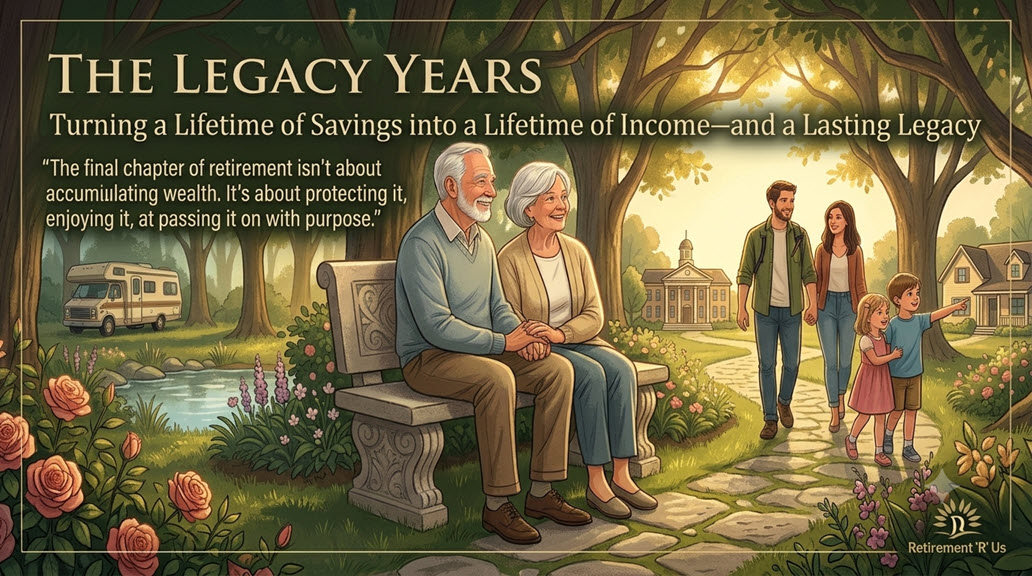
“The final chapter of retirement isn’t about accumulating wealth. It’s about protecting it, enjoying it, and passing it on with purpose.”
Grant is now in his late seventies. The retirement they dreamed about years earlier has become their reality. They’ve explored the country in their RV, watched their son graduate from college, celebrated anniversaries, welcomed grandchildren into the family, and created memories that were never possible during their working years.
Financially, they’re comfortable.
-
Not because they earned extraordinary investment returns.
-
Not because they predicted the stock market.
-
Not because they found the next hot investment.
They’re comfortable because they spent thirty years making thoughtful financial decisions—one year at a time.
Now, retirement enters its final phase. At Retirement “R” Us, we call this The Legacy Years. This is the stage where retirement planning shifts from maximizing opportunity to preserving flexibility, controlling taxes, and ensuring that the wealth you’ve built serves both your family and your values.
Retirement Doesn’t End When the Paychecks Stop
Many people think retirement planning ends the day they retire. In reality, that’s when a new kind of planning begins. During the Legacy Years, Grant and Chloe face questions that simply didn’t exist earlier in retirement:
-
How do they manage Required Minimum Distributions?
-
How do they prevent Medicare premiums from increasing unnecessarily?
-
How do they keep more of their Social Security benefits from becoming taxable?
-
What happens if one spouse passes away?
-
How can they leave their son an inheritance as tax-efficiently as possible?
These aren’t investment questions—they’re planning questions. And thoughtful planning often has a greater impact than chasing higher investment returns.
Required Minimum Distributions: The IRS Wants Its Share
For decades, Grant enjoyed the tax benefits of contributing to his traditional retirement accounts. Now the IRS expects repayment.
Required Minimum Distributions (RMDs) require retirees to withdraw a minimum amount from most pre-tax retirement accounts each year. Whether Grant needs the money or not is irrelevant. Whether the market had a good year or a bad year doesn’t matter. The distribution is required.
For retirees who ignored tax planning earlier, these mandatory withdrawals can create an unpleasant surprise:
-
Large RMDs may push retirees into higher tax brackets.
-
They may increase Medicare premiums.
-
They may cause more Social Security benefits to become taxable.
-
And because the withdrawals are mandatory, there’s often very little flexibility.
Fortunately, Grant and Chloe spent years preparing for this moment. By taking advantage of the Bridge Years and the Golden Window, they’ve already reduced the size of Grant’s traditional retirement account through strategic withdrawals and Roth conversions. Their Required Minimum Distributions are smaller than they otherwise would have been.
Small decisions made years ago are now paying dividends.
Retirement “R” Us Insight
The best RMD strategy isn’t finding a way around Required Minimum Distributions. It’s reducing the size of the account that generates them before they’re ever required.
The Widow’s Tax Trap
There is one retirement risk few couples like to discuss: eventually, one spouse is likely to outlive the other. Beyond the emotional loss comes an often-overlooked financial challenge.
The surviving spouse usually transitions from filing a joint tax return to filing as a single taxpayer. While household income may decrease, the tax brackets become much less favorable:
-
The same amount of income that was comfortably taxed on a joint return may now push the surviving spouse into higher tax brackets.
-
Medicare income thresholds also become more restrictive.
This is commonly known as the Widow’s Tax Trap, and it’s one of the most significant tax risks facing retired couples.
Grant and Chloe can’t prevent life’s uncertainties, but they can prepare for them. Because they’ve gradually built substantial Roth savings, the surviving spouse will have greater flexibility to meet spending needs without creating unnecessary taxable income. The Roth account becomes more than a retirement asset—it becomes a source of financial resilience during one of life’s most difficult transitions.
Social Security Isn’t Always Tax-Free
Many retirees are surprised to learn that Social Security benefits may become taxable. The amount depends on overall income—not simply the benefit itself.
When retirees rely heavily on taxable retirement account withdrawals, more of their Social Security benefits may become subject to federal income tax. This creates a ripple effect:
-
Higher federal taxes.
-
Increased Medicare premiums.
-
Less flexibility in future years.
Grant and Chloe’s diversified retirement income gives them options. If they need additional income in a particular year, they don’t always have to generate more taxable income. Sometimes they can supplement spending with Roth withdrawals instead. The result is greater control over their tax picture throughout retirement.
Giving with Purpose: Qualified Charitable Distributions
Throughout their lives, Grant and Chloe have supported causes that are meaningful to them. Retirement doesn’t change that—in fact, it creates a unique planning opportunity for charitable giving.
Once eligible, retirees can make Qualified Charitable Distributions (QCDs) directly from certain retirement accounts to qualified charities. These distributions can satisfy all or part of an RMD while reducing taxable income compared with taking the distribution personally and then writing a check to charity.
It’s a strategy that allows retirees to support the organizations they care about while potentially improving their overall tax picture. For families who regularly donate to charity, this can become one of retirement’s most effective planning tools.
Retirement “R” Us Insight
The goal isn’t simply to give generously. It’s to give intelligently. Tax-efficient giving can benefit both the charities you support and your own retirement plan.
Leaving a Legacy Instead of a Tax Problem
Grant and Chloe have always hoped to leave something meaningful for their son. Many parents focus primarily on the dollar amount they’ll leave behind. Equally important is what kind of assets they leave.
Different assets come with different tax characteristics:
-
Traditional Retirement Accounts: Often create future tax obligations.
-
Taxable Brokerage Accounts: May receive favorable tax treatment under current law.
-
Roth Accounts: Generally provide heirs with considerably more flexibility because qualified withdrawals are tax-free (though inherited Roth accounts are still subject to distribution rules).
A thoughtfully designed estate isn’t measured solely by its size. It’s measured by how efficiently it transfers wealth from one generation to the next. Every planning decision Grant and Chloe made during retirement contributes to that goal.
Annual Planning Never Stops
One of the biggest misconceptions about retirement planning is that it’s something you complete once. Successful retirement planning is an ongoing process.
Each year presents new questions:
-
Has tax legislation changed?
-
Did investment returns exceed expectations?
-
Have healthcare expenses increased?
-
Is a Roth conversion still appropriate?
-
Should charitable giving strategies be adjusted?
-
Have Required Minimum Distributions changed?
The most successful retirees don’t simply react to events. They review, adjust, and refine their plan every year. That’s why ongoing retirement planning can be just as valuable as the planning done before retirement begins.
Grant and Chloe’s Retirement Journey
Looking back, Grant realizes that retirement wasn’t defined by one major decision. It was shaped by hundreds of thoughtful choices:
-
Choosing which account to spend first.
-
Managing healthcare costs before Medicare.
-
Taking advantage of the Golden Window.
-
Completing measured Roth conversions.
-
Preparing for Required Minimum Distributions.
-
Planning for the surviving spouse.
-
Creating a tax-efficient legacy.
None of these decisions were dramatic on their own. Together, however, they transformed the financial outcome of their retirement.
The Retirement Visibility Strategy™ in Action
Throughout Grant and Chloe’s retirement, one principle guided every decision: Control what the IRS sees.
-
When they needed taxable income, they generated it strategically.
-
When they needed flexibility, they relied on tax-efficient assets.
-
When opportunities arose to reshape future taxes, they acted deliberately rather than reactively.
Instead of allowing the tax code to dictate their retirement, they designed a retirement that worked with the tax code. That distinction made all the difference.
Your Retirement May Be Closer Than You Think
Whether you’re five years from retirement or already enjoying it, the questions Grant and Chloe faced are likely the same questions you’ll eventually face:
-
Which account should I withdraw from first?
-
Should I convert part of my IRA to a Roth?
-
How do I avoid unnecessary Medicare premium increases?
-
How can I reduce future Required Minimum Distributions?
-
How do I protect my surviving spouse?
-
What’s the most tax-efficient way to leave an inheritance?
The answers aren’t the same for every family, but one principle applies to everyone: Retirement isn’t simply about generating income. It’s about generating tax-efficient income.
Retirement “R” Us Retirement Checklist
Before you finish reading, ask yourself these questions:
-
[ ] Do I know how much of my retirement income is taxable?
-
[ ] Have I identified which of my assets are fully taxable, partially taxable, and tax-free?
-
[ ] Do I have a withdrawal strategy instead of simply withdrawing from whichever account is most convenient?
-
[ ] Have I evaluated whether Roth conversions make sense during my lower-income years?
-
[ ] Have I estimated my future Required Minimum Distributions?
-
[ ] Have I considered how Medicare premiums may be affected by my retirement income?
-
[ ] Do I have a plan to protect my spouse if one of us passes away?
-
[ ] Have I reviewed how my assets will transfer to my children or other beneficiaries?
If you answered “no” to even one of these questions, your retirement plan may have opportunities for improvement.
Final Thoughts: It’s Not About Beating the Market
People often ask what separates retirees who thrive from those who constantly worry about money. It usually isn’t the size of their portfolio. It isn’t whether they earned 8% or 10% in the stock market. It isn’t whether they picked the perfect mutual fund.
More often, the difference comes down to planning.
Grant and Chloe didn’t build a successful retirement because they found secret investments. They built it because they understood that every retirement dollar carries its own tax consequences. They recognized that wealth accumulation and wealth distribution are two entirely different skill sets:
-
During working years: Success meant earning, saving, and investing.
-
During retirement: Success meant coordinating withdrawals, managing taxes, preserving flexibility, and making informed decisions year after year.
That’s the essence of the Retirement Visibility Strategy™:
-
It’s not about avoiding taxes—it’s about avoiding unnecessary taxes.
-
It’s not about eliminating income—it’s about controlling when and how income appears.
-
It’s not about predicting the future—it’s about preparing for it.
Because at the end of the day, retirement isn’t measured by how much money you’ve accumulated. It’s measured by how much freedom that money provides.
The families who enjoy the most confident retirements aren’t always the ones who saved the most. They’re often the ones who learned how to keep more of what they spent a lifetime earning.
At Retirement “R” Us, we believe that’s the retirement you’ve worked for—and the retirement you deserve.
Disclaimer
This article is for educational purposes only and should not be considered tax, legal, or investment advice. Every retirement situation is unique. Tax laws, Medicare rules, Social Security regulations, and estate planning strategies change over time and should be reviewed regularly. Before making financial decisions, consult with qualified tax, legal, and financial professionals who can evaluate your specific circumstances and help develop a strategy tailored to your goals.
Important Disclosures: Retirement “R” Us, a registered retirement planning advisor, provides this information for educational purposes only. It is not intended to offer personalized investment advice or suggest that any discussed securities or services are suitable for any specific investor. Readers should not rely solely on the information provided here when making investment decisions.
- Investing carries risks, including the potential loss of principal. No investment strategy can ensure a profit or protect against loss during market downturns.
- Past performance is not indicative of future results.
- The opinions shared are not meant to serve as investment advice or to predict future performance.
- While we believe the information provided is reliable, we do not guarantee its accuracy or completeness.
- This content is for educational purposes only and is not intended as personalized advice or a guarantee of achieving specific results. Consult your tax and financial advisors before implementing any discussed strategies.
- Everyone’s retirement circumstances, especially when it comes to health insurance and health care, are unique.
- Retirement “R” Us does not provide tax or legal advice. Please consult your tax advisor or attorney for advice tailored to your situation.
Legal Disclaimer: The information provided on this website is for general informational purposes only and is not intended to be legal advice. While we strive to ensure the accuracy and completeness of the information, we make no guarantees regarding its accuracy, completeness, or timeliness. The content is provided “as is” without any warranties of any kind, either express or implied.
Use of this website does not create an attorney-client relationship between the user and the website owner or any of its contributors. Users should not act upon the information provided without seeking professional legal counsel. Any reliance on the information provided is solely at the user’s own risk.
We are not responsible for any errors or omissions, or for any actions taken based on the information provided on this website. Links to third-party websites are provided for convenience only and do not constitute an endorsement or approval of their content. We are not liable for any damages arising from the use of or reliance on the information provided on this website or any linked third-party websites.
By using this website, you agree to the terms of this legal disclaimer. If you do not agree with these terms, please do not use this website.
Leave a Reply