
As Grant heads home after his final day on the job, one thought keeps replaying in his mind.
“I finally don’t have to worry about earning a paycheck anymore.”
And he’s right.
But a new challenge has quietly taken its place.
For the first time in nearly four decades, Grant and Chloe have complete control over their income.
During their working years, their employers largely dictated how much taxable income they earned each year.
Retirement changes that.
Now, every dollar they withdraw is a choice.
And every choice carries tax implications.
Ironically, the first few years after leaving work can be among the most valuable planning years of their entire financial lives.
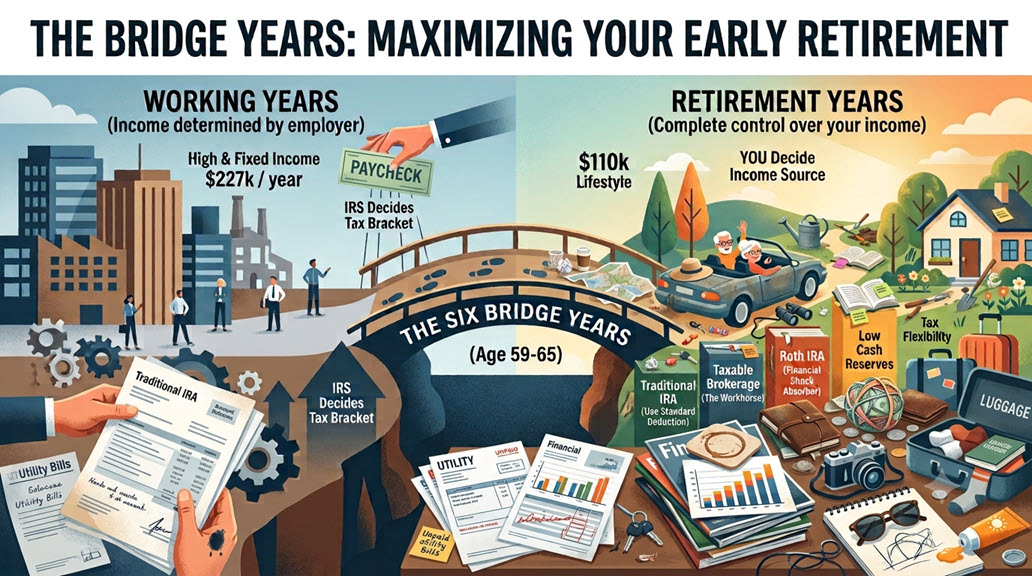
At Retirement “R” Us, we refer to this period as The Bridge Years because it spans the time between retirement and Medicare eligibility at age 65.
For Grant and Chloe, that period lasts about six years—a relatively brief window that offers tremendous financial opportunities.
The decisions they make during these years may significantly impact how much of their wealth they ultimately keep over the next thirty years.
Why the Bridge Years Matter So Much
Many retirees believe that retirement simply marks the beginning of spending their savings.
That’s true.
What they often fail to recognize is how dramatically their tax situation changes.
Consider the difference.
During Their Working Years
Grant and Chloe earned approximately $227,000 annually.
Most of their taxable income was predetermined.
They had very little flexibility.
In many ways, the IRS effectively determined their tax bracket.
During Retirement
Their target lifestyle requires approximately $110,000 per year.
Notice the difference.
Their spending needs have been reduced by roughly half.
But taxable income does not necessarily have to match spending.
This is where retirement planning becomes far more dynamic than the working years.
For the first time, Grant and Chloe can choose where their income comes from.
Instead of relying on a single paycheck, they now have access to multiple sources of income:
- Traditional retirement accounts
- Taxable investment accounts
- Roth accounts
- Cash reserves
Each source is taxed differently.
Using the wrong account at the wrong time can lead to unnecessary taxes.
Using the right account can create opportunities that simply weren’t available while they were working.
The Healthcare Challenge Before Medicare
Retiring also means losing employer-sponsored health insurance.
Until Medicare begins at age 65, Grant and Chloe must secure coverage through other options.
For many retirees, healthcare becomes one of their largest retirement expenses.
Depending on where they live, their age, and the level of coverage they choose, premiums can easily exceed $20,000 per year for a family.
Fortunately, the Affordable Care Act offers premium tax credits that can substantially reduce those costs for many early retirees.
There is, however, one important catch.
Eligibility is largely based on Modified Adjusted Gross Income (MAGI).
Not spending.
Not portfolio size.
Not net worth.
Income.
That’s why understanding income visibility during retirement becomes so critical.
Income and Lifestyle Are Not the Same Thing
Suppose Grant and Chloe need the full $110,000 each year to maintain their desired lifestyle.
That amount includes:
- Housing costs
- Utilities
- Groceries
- Health insurance
- Travel
- Entertainment
- Property taxes
- Home maintenance
- Their son’s activities
- College savings assistance
- Unexpected expenses
Their lifestyle requires $110,000.
But does that mean their tax return must show $110,000 of income?
Absolutely not.
And this is where many retirees unintentionally make a costly mistake.
The Most Common Retirement Mistake
Imagine Grant walks into his financial institution and says:
“We need $110,000 this year.”
The representative responds:
“No problem.”
The entire amount is withdrawn from his traditional IRA.
Simple.
Convenient.
And potentially one of the most expensive financial decisions he could make all year.
Why?
Because every dollar withdrawn increases taxable income.
The IRS now sees roughly $110,000 of additional ordinary income before factoring in investment earnings, dividends, or any part-time income Chloe may earn if she continues working.
That higher income can:
- Increase federal income taxes
- Reduce healthcare subsidies
- Raise future Medicare costs
- Cause more Social Security benefits to become taxable later
- Eliminate opportunities for strategic Roth conversions
Convenience often comes with a hidden cost.
A Better Approach to Creating Retirement Income
Instead of asking:
“Which account has enough money?”
Grant and Chloe should ask:
“Which account provides the income we need while generating the least amount of visible income?”
Here’s how that strategy can work.
Step One: Take Advantage of the Standard Deduction
One of the simplest retirement opportunities involves the federal standard deduction.
Think of it as income that the government generally allows you to receive before federal income taxes begin to apply.
Rather than avoiding traditional retirement accounts altogether, Grant and Chloe can intentionally withdraw enough to fully utilize this deduction.
Those dollars come from the traditional account while being taxed very efficiently.
Instead of letting that opportunity go unused, they make it work for them every year.
This strategy also gradually reduces future Required Minimum Distributions.
In retirement planning, small decisions repeated consistently often create significant long-term rewards.
Step Two: Allow the Brokerage Account to Carry More of the Load
Grant and Chloe’s taxable investment account may become the primary income source during the Bridge Years.
Why?
Because not every dollar withdrawn is taxable income.
Let’s say they originally invested $300,000, and the account eventually grew to $500,000.
A large portion of each withdrawal represents money on which they’ve already paid taxes.
Only the investment gains may be taxable.
And even then, long-term capital gains often receive favorable tax treatment.
In other words…
A $50,000 withdrawal does not necessarily create $50,000 of taxable income.
That’s an important distinction.
Step Three: Use the Roth as a Financial Shock Absorber
Retirement rarely unfolds exactly according to plan.
Eventually, a roof needs replacing.
A vehicle breaks down unexpectedly.
Medical expenses arise.
Or perhaps Grant and Chloe decide to take their dream trip to Alaska while they’re still young enough to hike the national parks.
Without Roth savings, unexpected spending often requires additional taxable withdrawals.
With Roth savings, they gain flexibility.
Need an extra $15,000?
Rather than increasing taxable income, they may be able to withdraw it from their Roth account.
Qualified Roth withdrawals generally do not appear as taxable income.
That’s why we often refer to the Roth as retirement’s pressure-release valve.
It helps absorb life’s surprises without creating unnecessary tax consequences.
Bringing the Strategy Together
Let’s return to their $110,000 spending goal.
Rather than taking everything from a single account, their income strategy might look something like this:
Traditional retirement account:
Withdraw enough to efficiently utilize the standard deduction.
Taxable brokerage account:
Provide most of the spending needs while keeping taxable income relatively low.
Cash reserves:
Use selectively to provide short-term flexibility.
Roth IRA:
Reserve for larger one-time expenses or years when additional taxable income would create unwanted consequences.
The result?
Grant and Chloe still enjoy the same lifestyle.
They still spend approximately $110,000 per year.
But they may report significantly less taxable income than retirees who rely solely on traditional retirement accounts.
That difference can affect taxes, healthcare costs, and future planning opportunities.
The Domino Effect of Smart Planning
A single good withdrawal decision rarely creates only one benefit.
More often, it creates four or five.
For Grant and Chloe, keeping visible income lower during the Bridge Years may help them:
✓ Reduce current federal income taxes.
✓ Improve eligibility for Affordable Care Act premium assistance.
✓ Postpone larger taxable withdrawals until a more strategic time.
✓ Preserve Roth assets for future flexibility.
✓ Keep future Medicare premiums lower by avoiding unnecessary income spikes before age 65.
Each advantage supports the next.
That’s why retirement income planning isn’t just about taxes.
It’s about understanding the entire financial picture.
This Is Only the Beginning
Many retirees believe the objective is to pay as little tax as possible this year.
That’s not actually the goal.
The real goal is to pay the least amount of tax over your lifetime.
Sometimes that means intentionally recognizing income today to avoid much larger tax bills later.
At first glance, that may seem counterintuitive.
But that concept leads directly into the next phase of Grant and Chloe’s retirement journey.
Because once Medicare begins, they enter what may be the greatest tax-planning opportunity of their lives.
It’s a period we call The Golden Window—a unique stretch of years when strategic Roth conversions can reduce future Required Minimum Distributions, lower lifetime taxes, and provide even greater control over retirement income.
Many retirees never realize this opportunity exists until it’s too late.
Grant and Chloe won’t be among them.
Important Disclosures: Retirement “R” Us, a registered retirement planning advisor, provides this information for educational purposes only. It is not intended to offer personalized investment advice or suggest that any discussed securities or services are suitable for any specific investor. Readers should not rely solely on the information provided here when making investment decisions.
- Investing carries risks, including the potential loss of principal. No investment strategy can ensure a profit or protect against loss during market downturns.
- Past performance is not indicative of future results.
- The opinions shared are not meant to serve as investment advice or to predict future performance.
- While we believe the information provided is reliable, we do not guarantee its accuracy or completeness.
- This content is for educational purposes only and is not intended as personalized advice or a guarantee of achieving specific results. Consult your tax and financial advisors before implementing any discussed strategies.
- Everyone’s retirement circumstances, especially when it comes to health insurance and health care, are unique.
- Retirement “R” Us does not provide tax or legal advice. Please consult your tax advisor or attorney for advice tailored to your situation.
Legal Disclaimer: The information provided on this website is for general informational purposes only and is not intended to be legal advice. While we strive to ensure the accuracy and completeness of the information, we make no guarantees regarding its accuracy, completeness, or timeliness. The content is provided “as is” without any warranties of any kind, either express or implied.
Use of this website does not create an attorney-client relationship between the user and the website owner or any of its contributors. Users should not act upon the information provided without seeking professional legal counsel. Any reliance on the information provided is solely at the user’s own risk.
We are not responsible for any errors or omissions, or for any actions taken based on the information provided on this website. Links to third-party websites are provided for convenience only and do not constitute an endorsement or approval of their content. We are not liable for any damages arising from the use of or reliance on the information provided on this website or any linked third-party websites.
By using this website, you agree to the terms of this legal disclaimer. If you do not agree with these terms, please do not use this website.
Leave a Reply