
On a warm Friday afternoon, just a few months before his 60th birthday, Grant Lawson shuts down his computer for the last time.
After nearly four decades of working as a Financial Manager and Controller, he’s ready for the next chapter. There are no more quarterly reports, no more budget meetings, and no more late-night conference calls. Waiting outside the office is Chloe, his wife, smiling as she imagines all the things they’ve talked about for years—traveling across the country, visiting national parks, spending more afternoons watching their seven-year-old son grow up, and finally living life on their own schedule.
Financially, they’ve done everything right.
They’ve accumulated more than $1.65 million in retirement assets.
- $850,000 in traditional retirement accounts
- $500,000 in a taxable investment portfolio
- $200,000 in Roth accounts
- $100,000 in cash reserves
- A $750,000 mortgage-free home
- A growing 529 college savings plan for their son
On paper, they’re the picture of retirement success.
Yet there’s one problem.
It has nothing to do with the stock market.
It has nothing to do with inflation.
It has nothing to do with running out of money.
Instead, it comes down to one surprisingly simple question.
Which account should they spend first?
Most retirees think that’s a minor detail.
In reality, it may be one of the most expensive financial decisions they’ll ever make.
The Hidden Retirement Tax Trap
Imagine two families.
Both retire with exactly the same investments.
Both earn the same market returns.
Both spend exactly $110,000 every year.
Thirty years later, one family has paid hundreds of thousands of dollars more in taxes, Medicare premiums, and healthcare costs than the other.
How is that possible?
They didn’t earn more money.
They didn’t invest better.
They didn’t take greater risks.
The only difference was the order in which they withdrew their retirement savings.
That single decision can determine whether you:
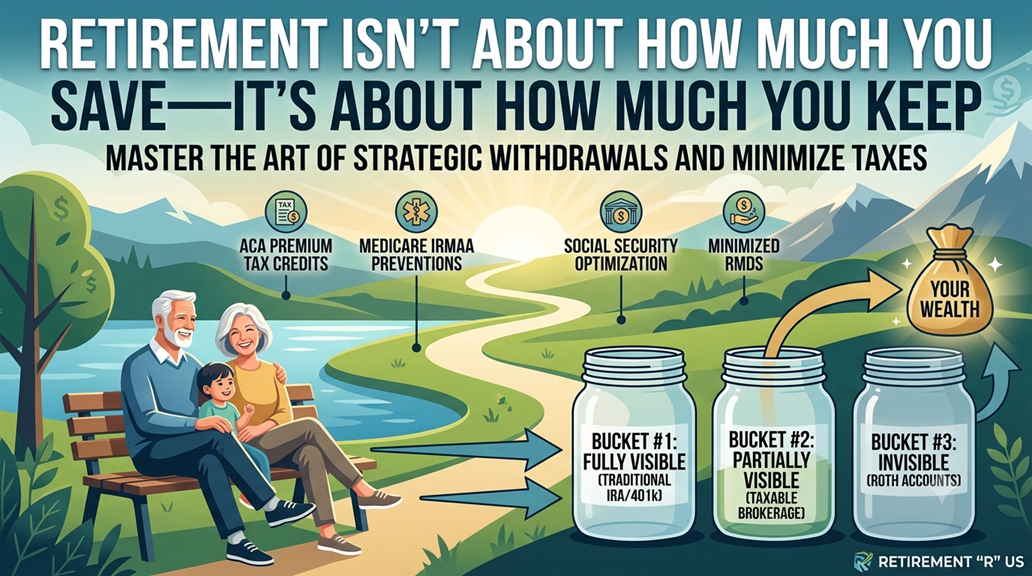
- Qualify for thousands of dollars in Affordable Care Act (ACA) premium subsidies before Medicare.
- Stay below Medicare IRMAA income thresholds after age 65.
- Reduce the amount of your Social Security benefits that become taxable.
- Minimize Required Minimum Distributions (RMDs) later in life.
- Leave more tax-efficient assets to your children.
Retirement isn’t just about accumulating wealth.
It’s about learning how to spend that wealth intelligently.
The IRS Doesn’t Tax Your Spending
This surprises almost everyone.
The IRS doesn’t actually care how much you spend each year.
It cares how much taxable income it sees.
Suppose Grant and Chloe spend $110,000 during retirement.
That number alone tells us almost nothing about their tax bill.
Why?
Because spending and taxable income are two completely different things.
Consider these two retirees.
Retiree A
Withdraws the entire $110,000 from a traditional 401(k).
To the IRS, nearly every dollar is taxable income.
Visible income: $110,000
Retiree B
Withdraws:
- $30,000 from a traditional IRA
- $50,000 from a taxable brokerage account, much of which represents original investment principal
- $30,000 from a Roth IRA
Same spending.
Same lifestyle.
Same vacation.
Same groceries.
Same utility bills.
But far less taxable income.
Visible income may be only a fraction of the $110,000 they actually spent.
One family lives on the same budget while paying dramatically less in taxes.
That’s the power of understanding retirement visibility.
Introducing the Retirement Visibility Strategy™
At Retirement “R” Us, we think about retirement income differently.
Instead of asking,
“How much money do you need?”
we ask,
“How much of your retirement spending does the IRS actually see?”
Every retirement account falls into one of three visibility categories.
Think of them as three different buckets.
Bucket #1 — The Fully Visible Bucket
This includes:
- Traditional IRAs
- Traditional 401(k)s
- 403(b)s
- Most pension income
Every dollar withdrawn generally appears on your tax return as ordinary income.
The IRS sees everything.
These withdrawals increase your Adjusted Gross Income (AGI), which can affect:
- Federal income taxes
- Medicare premiums
- Taxation of Social Security benefits
- Affordable Care Act subsidy eligibility
- State income taxes (depending on where you live)
For Grant and Chloe, this bucket currently holds about $850,000.
It’s also the bucket that deserves the most careful planning.
Bucket #2 — The Partially Visible Bucket
This is your taxable brokerage account.
Unlike retirement accounts, not every dollar withdrawn is taxable.
Some of what you withdraw is simply your original investment—the money you’ve already paid taxes on.
Only the investment gains may create taxable income.
Even better, long-term capital gains often receive more favorable tax treatment than ordinary income.
Grant and Chloe have approximately $500,000 in this bucket.
Used strategically, it can become one of the most valuable tools in reducing lifetime taxes.
Bucket #3 — The Invisible Bucket
This is where Roth accounts shine.
Qualified Roth withdrawals are generally federal income tax-free.
More importantly, they usually don’t increase taxable income.
Think of this bucket as your financial “stealth account.”
Need extra money for a new roof?
A dream vacation?
Helping your child through college?
A major medical expense?
You can often withdraw from a Roth account without increasing your taxable income.
Grant and Chloe currently have approximately $200,000 in Roth savings.
That money gives them tremendous flexibility throughout retirement.
Why Visibility Matters More Than Ever
Twenty years ago, retirees mainly worried about federal income taxes.
Today’s retirees face a much more complicated landscape.
Your income can affect far more than your tax bracket.
It can determine whether you qualify for valuable government benefits—or lose them.
Think of retirement as driving down a highway.
Along the way are invisible checkpoints.
Cross one of them, and the financial consequences can be immediate.
These checkpoints are what we call Retirement Mile Markers and Retirement Cliffs.
Understanding the difference could save your family tens of thousands of dollars.
Mile Markers vs. Cliffs
Most people assume taxes increase gradually.
Sometimes that’s true.
Those are mile markers.
For example, moving from one federal tax bracket into the next usually means only the dollars above the threshold are taxed at the higher rate.
The impact is relatively modest.
Cliffs are entirely different.
A cliff means crossing an income threshold can trigger a disproportionately large financial cost.
It’s like stepping off the edge of a mountain rather than climbing another stair.
Retirees face several of these cliffs throughout retirement.
For Grant and Chloe, the most important include:
Before Age 65
Affordable Care Act Premium Tax Credits
If household income becomes too high relative to available premium tax credits, they could lose thousands of dollars in healthcare assistance.
One unnecessary withdrawal from the wrong account could dramatically increase their annual health insurance costs.
After Age 65
Medicare IRMAA
Higher income can increase Medicare Part B and Part D premiums.
Many retirees are surprised to learn that Medicare isn’t simply based on age.
It’s also based on income.
Throughout Retirement
Social Security Taxation
Many people assume Social Security benefits are tax-free.
In reality, depending on your income, up to 85% of your benefits may become taxable.
Again, it’s not the benefit itself that creates the issue.
It’s the amount of visible income you generate from other sources.
Later Retirement
Required Minimum Distributions (RMDs)
Eventually, traditional retirement accounts begin forcing taxable withdrawals.
If no planning has been done beforehand, retirees often discover that the IRS has effectively chosen their tax bracket for them.
That’s a difficult position to be in.
The Good News
Grant and Chloe have one tremendous advantage.
They aren’t starting retirement with all of their money in one account.
Instead, they’ve built assets across multiple tax categories.
That gives them choices.
And in retirement, choices create opportunities.
The goal isn’t to avoid taxes altogether.
Every successful retiree pays taxes.
The goal is to pay taxes on your terms, rather than allowing the tax code to dictate when and how much you owe.
That’s where the Retirement Visibility Strategy becomes so powerful.
By understanding which dollars are visible and which are not, Grant and Chloe can potentially reduce taxes, lower healthcare costs, avoid unnecessary Medicare surcharges, and preserve more of their wealth for themselves and for their son.
The strategy isn’t about finding loopholes.
It’s about making smarter decisions with money they’ve already worked a lifetime to earn.
Coming Up in Part 2: The Bridge Years
For Grant and Chloe, the years between retirement and Medicare may become the most valuable tax-planning opportunity of their lives.
We’ll explore how a carefully designed withdrawal strategy during these early retirement years can help them control taxable income, preserve Affordable Care Act subsidies, and create the foundation for decades of tax-efficient retirement income.
Sometimes the first few years of retirement determine the success of the next thirty.
For the Lawsons, those years are about to begin.
Important Disclosures: Retirement “R” Us, a registered retirement planning advisor, provides this information for educational purposes only. It is not intended to offer personalized investment advice or suggest that any discussed securities or services are suitable for any specific investor. Readers should not rely solely on the information provided here when making investment decisions.
- Investing carries risks, including the potential loss of principal. No investment strategy can ensure a profit or protect against loss during market downturns.
- Past performance is not indicative of future results.
- The opinions shared are not meant to serve as investment advice or to predict future performance.
- While we believe the information provided is reliable, we do not guarantee its accuracy or completeness.
- This content is for educational purposes only and is not intended as personalized advice or a guarantee of achieving specific results. Consult your tax and financial advisors before implementing any discussed strategies.
- Everyone’s retirement circumstances, especially when it comes to health insurance and health care, are unique.
- Retirement “R” Us does not provide tax or legal advice. Please consult your tax advisor or attorney for advice tailored to your situation.
Legal Disclaimer: The information provided on this website is for general informational purposes only and is not intended to be legal advice. While we strive to ensure the accuracy and completeness of the information, we make no guarantees regarding its accuracy, completeness, or timeliness. The content is provided “as is” without any warranties of any kind, either express or implied.
Use of this website does not create an attorney-client relationship between the user and the website owner or any of its contributors. Users should not act upon the information provided without seeking professional legal counsel. Any reliance on the information provided is solely at the user’s own risk.
We are not responsible for any errors or omissions, or for any actions taken based on the information provided on this website. Links to third-party websites are provided for convenience only and do not constitute an endorsement or approval of their content. We are not liable for any damages arising from the use of or reliance on the information provided on this website or any linked third-party websites.
By using this website, you agree to the terms of this legal disclaimer. If you do not agree with these terms, please do not use this website.
Leave a Reply