
👩💼 Overview Snapshot
At 50, with nearly $1 million in assets and a federal pension on the horizon, Karen has a powerful foundation. But the real work — and the real opportunity — lies in the decade ahead.
| Metric | Value | Description |
|---|---|---|
| Investable Assets | $906K | Across all accounts |
| Target Spending | $65K | Per year in retirement |
| Retirement Age | 60 | 10 years away |
| Guaranteed Income | $37.2K | Pension + SS combined |
| Portfolio Gap | $28K | Annual draw needed |
There is a particular kind of financial anxiety that strikes well-prepared people. Not the panic of someone who has saved nothing, but the quieter worry of someone who has done almost everything right and wonders whether “almost” is enough.
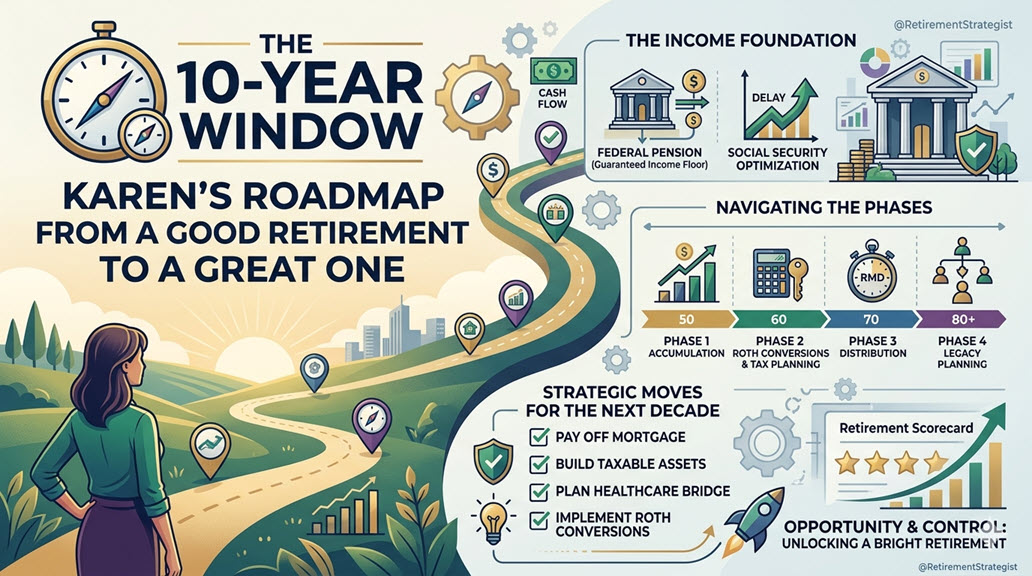
🧭 The Four Seasons of Retirement Planning
Before diving into specifics, it helps to understand the framework through which Karen’s plan is evaluated. Retirement planning unfolds in four distinct phases, each with different priorities, risks, and tools.
| Phase | Age | Title | Original Description |
|---|---|---|---|
| Phase 1 | 50–60 | Accumulation | Maximize contributions. Build tax diversity. Prepare for healthcare. |
| Phase 2 | 60–70 | Critical Tax Window | Roth conversions. SS delay. Low-tax bracket optimization. |
| Phase 3 | 70–80 | Distribution | RMD management. IRMAA avoidance. QCDs if charitable. |
| Phase 4 | 80+ | Legacy | Simplify. Estate planning. Long-term care. Beneficiary review. |
Karen is currently in Phase 1 — with a 10-year runway before she reaches what may be the most strategically important phase of her entire retirement journey.
💰 The Income Math: Why Her Numbers Actually Work
The single most reassuring fact about Karen’s retirement plan is how manageable her portfolio draw will be once her guaranteed income sources are combined.
Income Breakdown
| Income Source | Type | Annual Amount |
|---|---|---|
| FERS Federal Pension | Guaranteed, inflation-adjusted | ~$15,000 |
| Social Security (age 67) | Guaranteed, inflation-indexed | ~$22,200 |
| Total Guaranteed Income | ~$37,200 | |
| Retirement spending target | Annual goal | $65,000 |
| Portfolio gap to fill | From investments | ~$27,800 |
📊 Withdrawal Rate Visualization
Portfolio Draw Needed: ~$27,800
Portfolio Size: $906,000

Withdrawal Rate:
[███░░░░░░░░░░░░░░░░░░░] 3.1%

Safe Range:
[████████░░░░░░░░░░░░░] ~4%
That portfolio gap of roughly $27,800 per year represents only a 3.1% withdrawal rate… well within the conventional “safe withdrawal” range.
⚖️ Real-World Example
Consider two retirees both targeting $65,000/year.
| Scenario | Required Portfolio |
|---|---|
| No pension / no SS | ~$1.63 million |
| Karen’s setup | ~$695,000 |
| Karen today | $906,000 |
The pension alone is worth roughly $375,000 in equivalent portfolio value.
✅ Where Her Plan Is Genuinely Strong
🏛️ Federal Income Structure
Karen retires with three income floors: a defined-benefit pension, a substantial TSP balance, and Social Security.
🏡 Mortgage Situation
| Item | Amount |
|---|---|
| Home Value | ~$450,000 |
| Mortgage Balance | $10,000 |
This is a straightforward win: pay it off before retirement.
📉 Flexibility in Down Markets
If Karen retires debt-free… she could temporarily reduce spending from $65,000 to $50,000 without threatening housing.
🟣 Roth Assets
| Account | Value |
|---|---|
| Roth IRA | $125,000 |
Her Roth balance represents a flexible, tax-free reservoir she can draw from strategically.
⚠️ The Hidden Vulnerability: Tax Concentration Risk
Asset Allocation by Tax Type
Tax-Deferred:     ██████████████████ ~77%
Roth:             ████               ~14%
Taxable:          ██                 ~6%
Cash + HSA:       █                  ~3%
| Category | Amount |
|---|---|
| Tax-deferred (IRA + TSP) | ~$700,000 |
| Roth (after-tax) | ~$125,000 |
| Taxable brokerage | ~$55,000 |
| Cash + HSA | ~$26,000 |
Nearly 77% of Karen’s investable wealth is in tax-deferred accounts…
💣 The RMD Time Bomb
Required Minimum Distributions begin at age 73.
| Scenario | Value |
|---|---|
| Projected Balance | $1.2M |
| First RMD | ~$46,000 |
This could push her into higher tax brackets, trigger IRMAA…
🏥 Healthcare Bridge (Ages 60–65)
This creates a five-year window during which she must obtain private health insurance…
Cost Illustration
| Scenario | Monthly | Annual |
|---|---|---|
| Full cost | $800–$1,100 | $9,600–$13,200 |
| Subsidized | $200–$400 | $2,400–$4,800 |
The difference: $7,000–$11,000 per year…
📊 Why Taxable Accounts Matter
Withdrawals from a taxable account… can be structured to minimize MAGI…
🔄 Phase 2: Roth Conversion Strategy
This creates an extraordinary opportunity to deliberately convert portions…
Example Conversion
| Item | Amount |
|---|---|
| Pension Income | $15,000 |
| Standard Deduction | ~$16,000 |
| Conversion | $47,000 |
| Taxes | ~$5,640 |
Each year she does this, she permanently reduces the size of her future RMDs.
📉 Social Security Timing
| Age | Monthly | Annual |
|---|---|---|
| 67 | $1,850 | $22,200 |
| 70 | $2,300 | $27,600 |
Increase: +$5,400 annually
Break-even: ~Age 80
Delaying Social Security is, in effect, buying extremely cheap longevity insurance…
⏳ Longevity Risk
For Karen, this means her retirement plan must function for 30–35 years…
👤 The Single-Retiree Calculus
Karen faces this challenge without several buffers that couples enjoy…
🎯 Immediate Priorities (Next 12 Months)
| Priority | Action |
|---|---|
| TSP Contributions | Maximize contributions + catch-up |
| Mortgage | Pay off $10,000 |
| HSA | Fund and invest |
| Taxable Brokerage | Grow to $130K–$260K |
| Roth Modeling | Build 10-year projection |
| Healthcare Plan | Define ACA strategy |
📈 Retirement Scorecard
| Category | Grade |
|---|---|
| Savings progress | A− |
| Income stability | A |
| Tax diversification | B− |
| Healthcare planning | C+ |
| Long-term tax strategy | B |
| Overall readiness | A− |
The C+ in healthcare planning is the most urgent grade to improve…
🧾 The Bottom Line
Karen Jones is not in a situation that requires dramatic action or radical sacrifice. She is in a situation that rewards strategic precision.
🚀 Final Takeaway Visualization
Good Retirement  →  Great Retirement

Savings        ✅ Already done
Tax Strategy   🔄 Optimize
Healthcare     🔄 Plan ahead
Withdrawals    🔄 Sequence correctly
The opportunity is real, the window is open, and the outcome is genuinely within Karen’s control.
Important Disclosures: Retirement “R” Us, a registered retirement planning advisor, provides this information for educational purposes only. It is not intended to offer personalized investment advice or suggest that any discussed securities or services are suitable for any specific investor. Readers should not rely solely on the information provided here when making investment decisions.
- Investing carries risks, including the potential loss of principal. No investment strategy can ensure a profit or protect against loss during market downturns.
- Past performance is not indicative of future results.
- The opinions shared are not meant to serve as investment advice or to predict future performance.
- While we believe the information provided is reliable, we do not guarantee its accuracy or completeness.
- This content is for educational purposes only and is not intended as personalized advice or a guarantee of achieving specific results. Consult your tax and financial advisors before implementing any discussed strategies.
- Everyone’s retirement circumstances, especially when it comes to health insurance and health care, are unique.
- Retirement “R” Us does not provide tax or legal advice. Please consult your tax advisor or attorney for advice tailored to your situation.
Legal Disclaimer: The information provided on this website is for general informational purposes only and is not intended to be legal advice. While we strive to ensure the accuracy and completeness of the information, we make no guarantees regarding its accuracy, completeness, or timeliness. The content is provided “as is” without any warranties of any kind, either express or implied.
Use of this website does not create an attorney-client relationship between the user and the website owner or any of its contributors. Users should not act upon the information provided without seeking professional legal counsel. Any reliance on the information provided is solely at the user’s own risk.
We are not responsible for any errors or omissions, or for any actions taken based on the information provided on this website. Links to third-party websites are provided for convenience only and do not constitute an endorsement or approval of their content. We are not liable for any damages arising from the use of or reliance on the information provided on this website or any linked third-party websites.
By using this website, you agree to the terms of this legal disclaimer. If you do not agree with these terms, please do not use this website.
Leave a Reply