
There’s a recurring scene I see in planning meetings. A client has done everything right — maxed out their accounts, paid off their house, built a portfolio worth multiple times their annual spending. By every reasonable metric, they’ve won. And they’re still not retiring.
“I’ll just work one more year.”
Then the next year comes. Same words. Same plan. And another year passes.
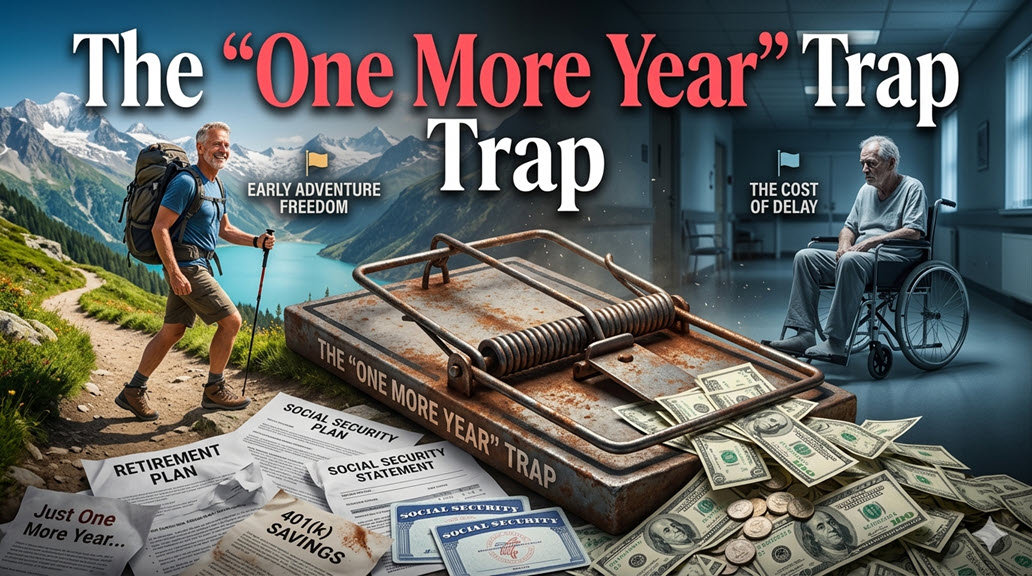
This is the one more year trap. And it’s one of the most insidious psychological obstacles to early retirement — not because it’s irrational, but because it feels rational the entire time.
Why It Feels So Reasonable
Here’s the uncomfortable truth: every argument for working one more year is actually a good argument. Let me walk through them.
More money. Two more years of contributions, two more years of compound growth — that can mean hundreds of thousands of additional portfolio value. In a world where you’re optimizing for maximum security, that’s meaningful.
Higher Social Security. Every year you delay claims past your full retirement age, your benefit grows roughly 8% per year. For someone with a solid earning record, waiting to 70 can mean a meaningfully higher guaranteed income for life.
Healthcare. As we discussed in an earlier post, employer-sponsored insurance is often far cheaper than ACA marketplace coverage. One more year of employer health benefits is worth real money.
Rational uncertainty. You’re not certain the market will perform as expected. You’re not certain your spending estimates are right. You’re not certain your health will hold. More margin feels safer.
All of these arguments are correct. And all of them, taken together, can keep you on the treadmill forever.
The Maximum Enjoyment Point Framework
The idea: every age has a theoretical ceiling on how much enjoyment you can extract from life. A 55-year-old can hike, travel, start a new business, fall in love, learn to sail — all the things that require vitality and time. An 85-year-old, no matter how healthy, faces hard limits on what’s actually possible.
Author Bill Perkins reframes this problem in his book Die With Zero through a concept he calls Maximum Enjoyment Points (MEPs).
Every year you delay retirement from 55 to 65, you’re accumulating more wealth — but you’re spending from a finite and shrinking account of high-quality experiences. You’re trading peak enjoyment years for later security.
Perkins’ argument isn’t to spend everything. It’s to be honest about what you’re actually trading when you choose more savings over more time. If you die with $2 million you never spent because you were afraid of running short, you didn’t win. You just chose the wrong prize.
The Trap Never Fully Goes Away
Here’s what surprises people: the one more year problem doesn’t disappear at traditional retirement age. I’ve seen clients retire at 65 and immediately second-guess themselves. Should I have waited until 67? What about the extra Social Security?
The fear doesn’t care about your timeline. It cares about control — and control is an illusion in retirement planning. You will never have enough certainty to feel “ready.” At some point, the decision has to become a decision.
The Difference Between Caution and Paralysis
I’m not suggesting you throw caution to the wind. I’m suggesting you examine whether the caution is actually serving your goals — or whether it’s serving a fear of regret that you can’t actually eliminate by working longer.
There’s a meaningful difference between:
- Caution: Running detailed projections, identifying real risks, building in real buffers where the numbers justify it
- Paralysis: Delaying indefinitely because certainty isn’t available, regardless of how strong the financial position already is
Most people in the one more year trap are in paralysis territory. The numbers said “ready” three years ago. They’re still working because the emotional threshold hasn’t caught up.
How to Break the Pattern
A few practical approaches that help:
- Pre-commit to a number. Before you reach retirement, set a target — a specific portfolio size, a specific age — and write it down. When you hit it, the decision is already made. You’re not deciding in the moment; you’re honoring a prior commitment to yourself.
- Separate the money question from the identity question. A lot of “one more year” thinking isn’t really about money. It’s about identity — who am I if I’m not working? The answer to that question has to exist before retirement, not after.
- Test drive retirement. Take a sabbatical. Travel for a month. Try the routine you’re imagining before you commit to it permanently. Anxiety about the unknown is much easier to manage when the unknown isn’t completely unknown.
- Quantify what you’re trading. If you have enough money to retire at 55 but you’re working until 60, you’re trading five years of your late-50s for extra security in your 80s and 90s. Is that a trade you would make if you were being completely honest about what those years are worth?
The Choice You’re Actually Making
Early retirement isn’t really about money — or rather, it’s about money the same way a compass is about north. The money gets you pointed in the right direction, but at some point you have to actually go.
What you’re choosing between, ultimately, is more time or more money. Not the appearance of security, not the comfort of a bigger number on a spreadsheet. Time — specifically, time at an age when time is worth the most to you.
Nobody on their deathbed wishes they’d worked more. That’s not inspirational fluff. That’s a specific, empirically observable pattern in end-of-life research. And it has real implications for how you should think about “one more year.”
The question isn’t whether you can afford to retire. It’s whether you can afford not to.
Next week: why the portfolio strategy that got you to early retirement might be the wrong one for staying retired — and how to think about asset allocation differently when your time horizon stretches decades beyond your working career.
Important Disclosures: Retirement “R” Us, a registered retirement planning advisor, provides this information for educational purposes only. It is not intended to offer personalized investment advice or suggest that any discussed securities or services are suitable for any specific investor. Readers should not rely solely on the information provided here when making investment decisions.
- Investing carries risks, including the potential loss of principal. No investment strategy can ensure a profit or protect against loss during market downturns.
- Past performance is not indicative of future results.
- The opinions shared are not meant to serve as investment advice or to predict future performance.
- While we believe the information provided is reliable, we do not guarantee its accuracy or completeness.
- This content is for educational purposes only and is not intended as personalized advice or a guarantee of achieving specific results. Consult your tax and financial advisors before implementing any discussed strategies.
- Everyone’s retirement circumstances, especially when it comes to health insurance and health care, are unique.
- Retirement “R” Us does not provide tax or legal advice. Please consult your tax advisor or attorney for advice tailored to your situation.
Legal Disclaimer: The information provided on this website is for general informational purposes only and is not intended to be legal advice. While we strive to ensure the accuracy and completeness of the information, we make no guarantees regarding its accuracy, completeness, or timeliness. The content is provided “as is” without any warranties of any kind, either express or implied.
Use of this website does not create an attorney-client relationship between the user and the website owner or any of its contributors. Users should not act upon the information provided without seeking professional legal counsel. Any reliance on the information provided is solely at the user’s own risk.
We are not responsible for any errors or omissions, or for any actions taken based on the information provided on this website. Links to third-party websites are provided for convenience only and do not constitute an endorsement or approval of their content. We are not liable for any damages arising from the use of or reliance on the information provided on this website or any linked third-party websites.
By using this website, you agree to the terms of this legal disclaimer. If you do not agree with these terms, please do not use this website.
Leave a Reply