
You planned for healthcare in retirement. You accounted for Medicare premiums and maybe even built up a health savings account. But if you’re retiring in your 50s, there’s a gap Medicare doesn’t cover: the years between retirement and age 65, when you’re entirely on your own—and the costs during that period can be shocking.
This is the healthcare trap of early retirement. And most people don’t realize it exists until they’re already caught in it.
The ACA Reality
If you retire before 65, your health insurance will most likely come through the Affordable Care Act (ACA) marketplace. What you pay each month isn’t determined by your age or medical history. It hinges on a single number: your Modified Adjusted Gross Income (technically, ACA-specific MAGI, but effectively your reported income).
Report a low income, and subsidies can reduce your healthcare costs to almost nothing. Report a higher income, and you may be paying $1,000 or more per month per person for the exact same plan.
The difference isn’t minor. It’s devastating.
The Subsidy Cliff
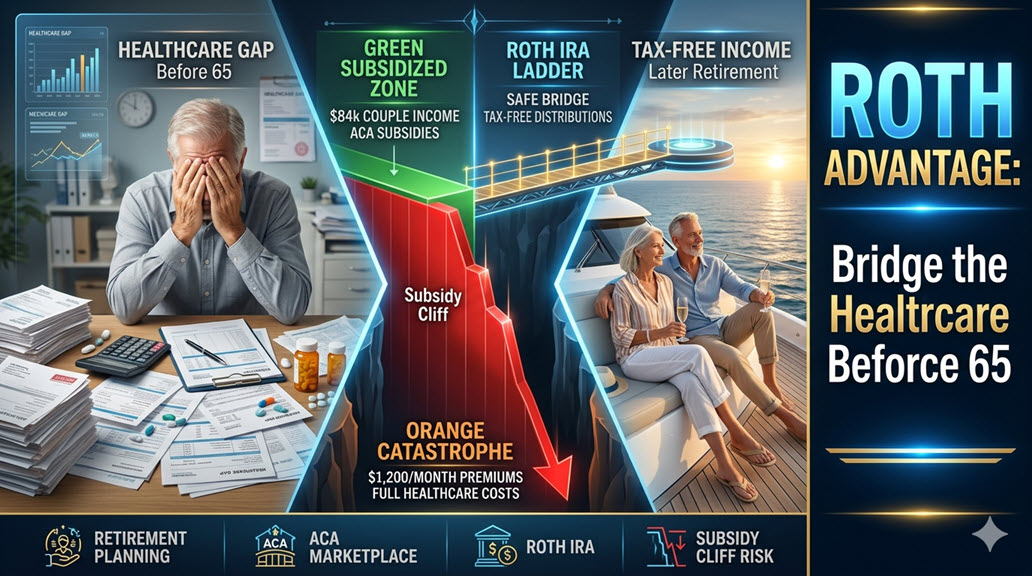
This is where many people get blindsided: the ACA subsidy cliff.
Below a certain income level, you qualify for income-based subsidies that significantly reduce your monthly premiums. But cross that threshold—even slightly—and you fall off the cliff. The subsidies disappear. Overnight, your premiums can jump by hundreds or even close to a thousand dollars per month.
For a married couple, that cliff sits at about $84,600 of reported income (400% of the federal poverty level for a two-person household). Go just one dollar over, and you’re suddenly paying full price.
For a single person, the threshold is lower—but the penalty for crossing it is just as severe. A single retiree reporting $60,000 in income might pay $300 per month for a solid plan. Report $65,000, and the same plan could cost nearly $1,200 per month. That’s a $900 monthly increase for $5,000 of additional income—effectively a 20% penalty on every extra dollar earned.
The Tax-Order Problem
What makes this so difficult is that ACA income isn’t your gross income. It depends heavily on which accounts you withdraw from.
Here’s how different sources of withdrawals affect your ACA reported income:
- Traditional IRA / 401(k) withdrawals count dollar for dollar. Every $1 withdrawn adds $1 to your reported income. Living on $80,000 from a traditional IRA means reporting $80,000 to the ACA.
- Roth withdrawals count as zero. This is the often-overlooked advantage of Roth accounts in early retirement. You could withdraw $1 million from Roth accounts and report none of it for ACA purposes—potentially qualifying for full subsidies.
- Social Security counts dollar for dollar as well, even if the benefit is otherwise untaxed. This is one reason many early retirees delay Social Security—not because they don’t need the income, but because taking it earlier inflates reported income and wipes out subsidies.
- Taxable account withdrawals only partially count. Only the capital gain portion is included. If you sell $100,000 of stock with a $60,000 cost basis, only $40,000 is counted. That makes taxable accounts a useful middle ground.
The Roth Advantage No One Talks About
Most financial planning discussions frame Roth accounts as a tax strategy: pay taxes now so withdrawals are tax-free later. That’s true—but for early retirees, Roth accounts offer another equally powerful benefit: they don’t interfere with ACA subsidies.
In a system where crossing an income threshold can cost you $10,000 or more per year in lost healthcare subsidies, having $500,000 or $1 million in Roth assets isn’t just smart tax planning. It’s a healthcare cost-control strategy.
That’s why I often tell clients considering early retirement that the type of money they have matters just as much as the total amount.
The Optimization Play
You don’t need to live on almost nothing to get substantial healthcare subsidies. You simply need to be deliberate about where your income comes from.
In practice, that often means:
- Drawing first from taxable accounts, which only partially count
- Strategically supplementing with Roth withdrawals
- Delaying Social Security to avoid triggering the subsidy cliff
- Managing withdrawal amounts to keep reported income below key thresholds
This isn’t about frugality. It’s about sequencing. Choosing which accounts to tap—and when—is a planning problem with a solution. But it’s a problem you need to identify before retirement, not after.
The Real Cost of Getting It Wrong
To be clear, healthcare costs aren’t a reason to abandon the idea of early retirement. With good planning, they’re usually manageable. But getting this wrong can mean paying $20,000 to $30,000 more per year than necessary during the most active years of your retirement.
Over the decade before Medicare eligibility, that’s $200,000 to $300,000 in avoidable expense. That’s not a rounding error. That’s an entire luxury car’s worth of wealth lost to premiums alone.
The Bottom Line
If early retirement is part of your plan, healthcare strategy isn’t something to figure out afterward. It’s something you plan for years in advance—specifically how much income you’ll show, which accounts you’ll withdraw from, and in what order.
Run the numbers before you retire. Model your withdrawal strategy. And if most of your savings are in traditional retirement accounts with little or no Roth balance, start thinking seriously about whether a conversion strategy makes sense.
Healthcare won’t be free in early retirement. But with the right plan, it doesn’t have to be catastrophic.
Next week: why traditional rules like the 4% rule often fail early retirees—and what dynamic spending strategies actually look like in the real world.
Important Disclosures: Retirement “R” Us, a registered retirement planning advisor, provides this information for educational purposes only. It is not intended to offer personalized investment advice or suggest that any discussed securities or services are suitable for any specific investor. Readers should not rely solely on the information provided here when making investment decisions.
- Investing carries risks, including the potential loss of principal. No investment strategy can ensure a profit or protect against loss during market downturns.
- Past performance is not indicative of future results.
- The opinions shared are not meant to serve as investment advice or to predict future performance.
- While we believe the information provided is reliable, we do not guarantee its accuracy or completeness.
- This content is for educational purposes only and is not intended as personalized advice or a guarantee of achieving specific results. Consult your tax and financial advisors before implementing any discussed strategies.
- Everyone’s retirement circumstances, especially when it comes to health insurance and health care, are unique.
- Retirement “R” Us does not provide tax or legal advice. Please consult your tax advisor or attorney for advice tailored to your situation.
Legal Disclaimer: The information provided on this website is for general informational purposes only and is not intended to be legal advice. While we strive to ensure the accuracy and completeness of the information, we make no guarantees regarding its accuracy, completeness, or timeliness. The content is provided “as is” without any warranties of any kind, either express or implied.
Use of this website does not create an attorney-client relationship between the user and the website owner or any of its contributors. Users should not act upon the information provided without seeking professional legal counsel. Any reliance on the information provided is solely at the user’s own risk.
We are not responsible for any errors or omissions, or for any actions taken based on the information provided on this website. Links to third-party websites are provided for convenience only and do not constitute an endorsement or approval of their content. We are not liable for any damages arising from the use of or reliance on the information provided on this website or any linked third-party websites.
By using this website, you agree to the terms of this legal disclaimer. If you do not agree with these terms, please do not use this website.
Leave a Reply