
If you’re a single person planning to retire before 65, your biggest tax threat may not be income taxes at all—it may be health insurance cliffs and hidden phase‑outs that can quietly cost you thousands. Many financial advisors still say, “Just convert to Roth in your low‑income years.”
But for early retirees—especially single ones—that advice often backfires.
Today’s case study shows why.
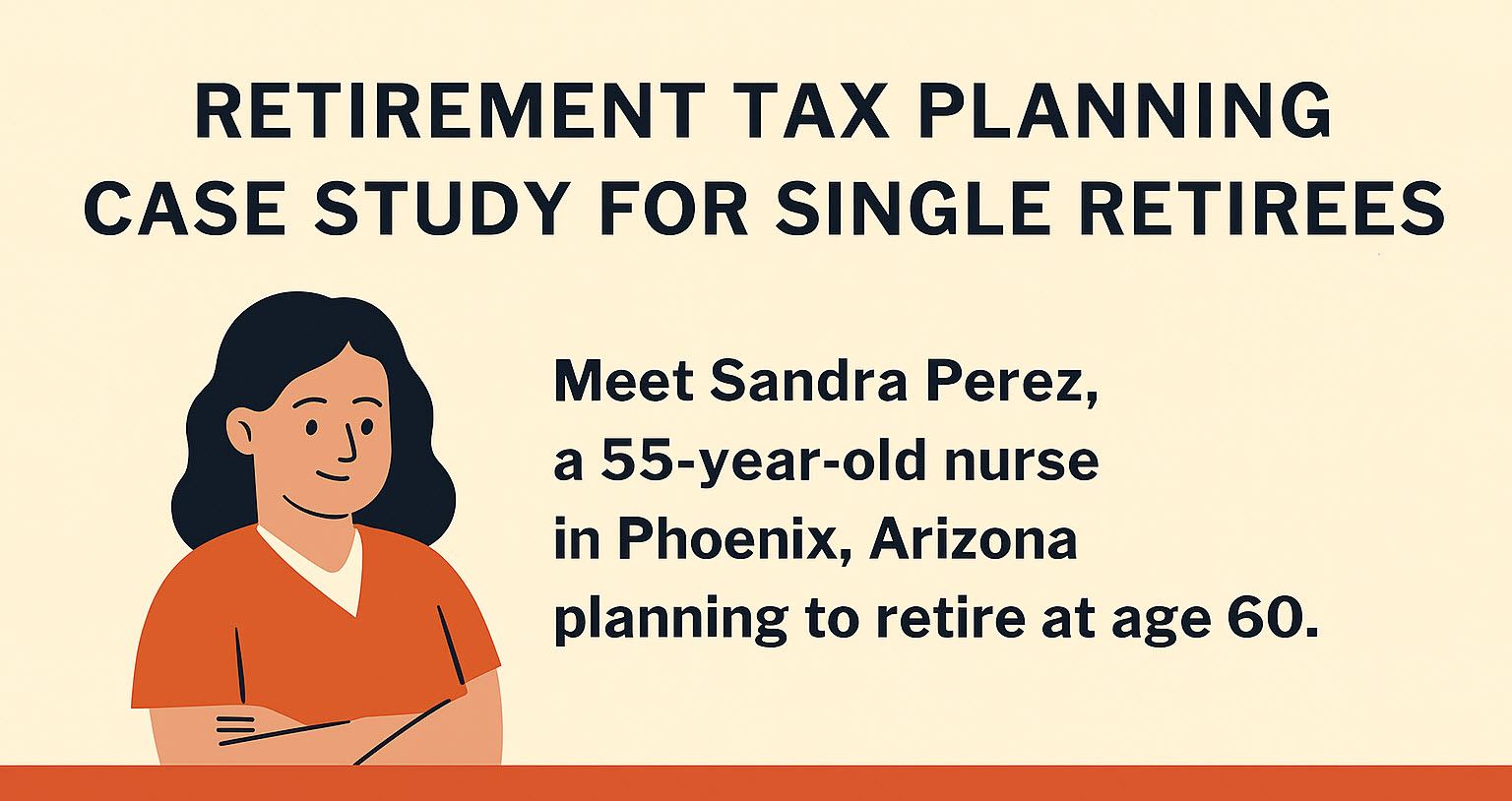
Meet Sandra Perez, a 55‑year‑old nurse in Phoenix, Arizona, planning to retire at age 60. Sandra wants to maintain a comfortable lifestyle while keeping taxes and health insurance premiums under control.
This case study reveals the exact tax strategy that allowed Sandra to protect ACA subsidies, avoid hidden tax traps, and optimize withdrawals—without aggressive Roth conversions.
Sandra’s Retirement Profile
Age: 55 (retiring at 60)
Status: Single
Location: Phoenix, Arizona
Annual retirement spending goal: $75,000 (after tax)
Assets:
- 401(k): $144,000
- Roth IRA: $64,000
- HSA: $16,000
- Taxable brokerage: $48,000
- Cash savings: $48,000
- Home: Owned free & clear (value $380,000)
Future income:
- Social Security at 67: $2,350/month
At first glance, advisors may say Sandra should convert heavily into the 22% bracket now. But as you’ll see, that approach would cost her thousands in lost ACA subsidies and unnecessary taxes.
Phase 1 (Ages 60–64): Pre‑Medicare Tax Planning and ACA Subsidy Protection
From age 60 to 64, Sandra will rely on Marketplace/ACA health insurance. For single retirees, this is the most fragile phase of retirement tax planning.
📌 Key Tax Rule for Single ACA Enrollees
The 400% Federal Poverty Level (FPL) cliff for a household of one is approximately:
$58,320 MAGI (2026 plans, based on 2025 FPL estimates)
If Sandra exceeds this income, even by $1, her premium tax credits disappear.
In Phoenix, Marketplace subsidies for a 60‑year‑old can easily exceed:
$7,000–$12,000 per year
Losing these subsidies would devastate her retirement budget.
Sandra’s MAGI Strategy
Sandra needs $75,000 net for living expenses.
To stay under the ACA cliff, she will rely on:
- Taxable brokerage withdrawals (with modest long-term gains)
- Cash reserves
- Roth IRA withdrawals (do not count toward MAGI)
- HSA for tax‑free medical expenses
Assuming her taxable account has ~20% long‑term capital gains, selling $40,000 might create:
- ~$8,000 LTCG → this is her primary source of MAGI
That keeps her annual MAGI roughly at:
MAGI ≈ $8,000 (far below the $58k cliff)
Which means:
✔ Full ACA subsidies
✔ Minimal federal tax
✔ No penalty for capital gains
✔ Maximum flexibility
❌ Why Roth conversions are dangerous here
Let’s model a few common conversion amounts:
| Roth Conversion | Estimated MAGI | Outcome |
|---|---|---|
| $15,000 | ~$23,000 | Subsidies shrink slightly, still okay |
| $40,000 | ~$48,000 | Near the cliff—premiums increase |
| $60,000 | ~$68,000 | Cliff crossed → subsidies drop to $0 |
A large Roth conversion at age 60 could increase Sandra’s health insurance cost by:
$10,000+ per year
This is a costly mistake many early retirees make—because most advisors don’t account for ACA rules.
Phase 1 Verdict: No (or tiny) Roth conversions
Sandra’s best strategy from 60–64:
- Keep MAGI well below $58k
- Use taxable + Roth + cash to fund spending
- Treat ACA subsidies as an asset worth protecting
- Only consider micro‑conversions if they don’t risk the cliff
Phase 2 (Ages 65–67): Medicare Years and Smart Roth Conversion Windows
At 65, Sandra moves to Medicare. ACA cliffs no longer apply, which opens new tax‑planning opportunities.
But she still needs $75,000 net annually, so her withdrawals must be chosen carefully.
Single Filer Tax Landscape (2026 Estimated)
- Standard deduction: ~$16,000
- Senior add‑on (65+): ~$1,650
- 22% bracket begins around $48,551 taxable income
Much narrower than married filing jointly.
⚠ The Enhanced Senior Deduction (2025–2028)
Single filers receive a temporary:
$6,000 additional deduction
But it phases out rapidly:
- Begins at $75,000 MAGI
- Ends at ~$125,000 MAGI
Every dollar Sandra converts during the phase‑out:
- Increases taxable income
- Reduces her deduction
- Causes an effective marginal tax rate of 24–26%+, even while “in the 22% bracket”
This means Sandra should not convert blindly.
Phase 2 Verdict: Limited, carefully targeted conversions
During Medicare years, conversions may help only if:
- They stay below key phase‑out thresholds
- They reduce future RMD pressure
- They avoid stacking income once Social Security starts
Sandra’s Final Retirement Tax Strategy
After modeling multiple scenarios, the optimal plan included:
✔ Very few Roth conversions
✔ Maximum ACA subsidy protection years
✔ Tight MAGI control using taxable + Roth + cash
✔ Avoiding deduction phase‑outs at 65+
✔ Strategic withdrawals that reduce lifetime taxes
✔ Coordinated timing with Social Security at 67
Key Takeaway: Roth Conversions Are Not Automatic
For single retirees, the right question isn’t:
“Should I convert in my low‑income years?”
It’s:
“What does this extra income break?”
- ACA subsidies?
- Senior enhanced deduction?
- Medicare IRMAA brackets?
- Social Security taxation?
For Sandra, avoiding the ACA cliff and protecting key deductions created far more savings than aggressive conversions ever could.
Thinking About Early Retirement?
If you’re a single retiree—or planning to retire before 65—your tax planning window is filled with traps advisors often overlook.
We help retirees model their exact tax and health insurance scenarios so they can retire confidently without overpaying.
👉 Want your personalized early‑retirement tax plan? Book a call today.
Important Disclosures: Retirement “R” Us, a registered retirement planning advisor, provides this information for educational purposes only. It is not intended to offer personalized investment advice or suggest that any discussed securities or services are suitable for any specific investor. Readers should not rely solely on the information provided here when making investment decisions.
- Investing carries risks, including the potential loss of principal. No investment strategy can ensure a profit or protect against loss during market downturns.
- Past performance is not indicative of future results.
- The opinions shared are not meant to serve as investment advice or to predict future performance.
- While we believe the information provided is reliable, we do not guarantee its accuracy or completeness.
- This content is for educational purposes only and is not intended as personalized advice or a guarantee of achieving specific results. Consult your tax and financial advisors before implementing any discussed strategies.
- Everyone’s retirement circumstances, especially when it comes to health insurance and health care, are unique.
- Retirement “R” Us does not provide tax or legal advice. Please consult your tax advisor or attorney for advice tailored to your situation.
Legal Disclaimer: The information provided on this website is for general informational purposes only and is not intended to be legal advice. While we strive to ensure the accuracy and completeness of the information, we make no guarantees regarding its accuracy, completeness, or timeliness. The content is provided “as is” without any warranties of any kind, either express or implied.
Use of this website does not create an attorney-client relationship between the user and the website owner or any of its contributors. Users should not act upon the information provided without seeking professional legal counsel. Any reliance on the information provided is solely at the user’s own risk.
We are not responsible for any errors or omissions, or for any actions taken based on the information provided on this website. Links to third-party websites are provided for convenience only and do not constitute an endorsement or approval of their content. We are not liable for any damages arising from the use of or reliance on the information provided on this website or any linked third-party websites.
By using this website, you agree to the terms of this legal disclaimer. If you do not agree with these terms, please do not use this website.
Leave a Reply